11 Aug 2026
SMS Verification for Developers: A Practical Guide to OTP APIs
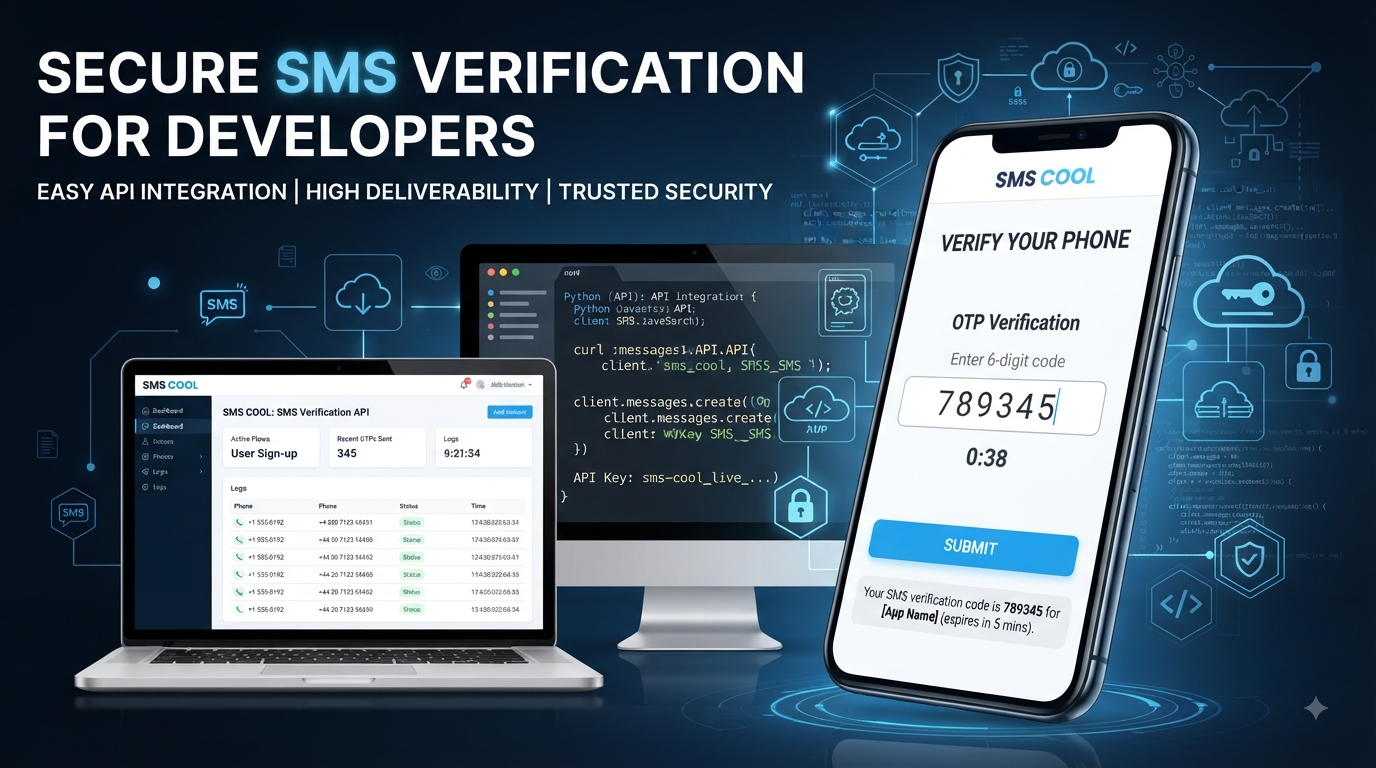
SMS Verification for Developers: A Practical Guide to OTP APIs
For many modern applications, a phone number is more than a contact detail. It can be an important part of user identity, account security, onboarding, and fraud prevention. That is why SMS verification for developers remains a practical way to confirm that users have access to the phone numbers they provide.
The basic idea is simple: generate a one-time password, send it to the user's phone, and ask them to enter the code inside the application. Behind that simple experience, however, developers need to manage API integration, delivery, security, retries, rate limits, expiration, and error handling.
A dependable SMS verification API can take much of the communication complexity out of this process. For developers looking for a practical way to build OTP and phone verification workflows, SMS COOL provides a developer-focused solution for integrating SMS-based verification into applications.
What Is SMS Verification for Developers?
SMS verification for developers is the process of using text messages and one-time passwords to confirm that a user controls a particular phone number.
A typical application asks a new user to enter their mobile number. The backend then generates an OTP and sends it through an SMS provider. The user enters the received code, and the application checks whether the code is valid.
If the code matches, the phone number can be marked as verified.
This approach is commonly used for:
- User registration
- Login protection
- Account recovery
- Phone number verification
- Two-factor authentication
- Customer onboarding
- Sensitive account actions
Instead of building an entire SMS delivery infrastructure from scratch, developers can connect their application to a developer SMS API and manage verification through API-based requests.
Why SMS Verification Matters
User authentication needs to balance security with convenience. If verification is too complicated, users may abandon registration. If it is too weak, fraudulent or automated activity can become harder to control.
SMS verification provides a familiar workflow that most mobile users already understand.
User Registration
Applications can require a user to verify their mobile number before completing account creation. This helps ensure that the submitted number is actually accessible to the user.
Login Security
SMS-based verification can be added as an additional authentication step. For example, an application may request a password and then send an SMS OTP before allowing access.
Account Recovery
When users lose access to a password or need to confirm ownership of an account, phone verification can provide another authentication channel.
Fraud Prevention
Requiring phone verification can add friction to automated account creation and certain suspicious activities. It should be treated as one layer of a broader security strategy rather than a complete fraud-prevention system.
Two-Factor Authentication
2FA SMS verification can provide an additional verification step beyond a password. For applications where SMS is an appropriate authentication method, an OTP can help strengthen the login process.
How SMS Verification Works
A typical SMS OTP workflow is straightforward.
1. The User Enters a Phone Number
The application asks the user to provide their mobile number, ideally in a standardized international format.
2. The Application Requests an OTP
The backend creates or requests a one-time verification code and associates it with the relevant user or verification session.
3. The SMS Verification API Sends the Code
The application sends the verification request to its SMS provider. The provider handles SMS delivery to the user's mobile number.
4. The User Enters the OTP
The user receives the SMS and enters the code into the application.
5. The Application Validates the Code
The backend checks the submitted OTP against the active verification request.
6. The Application Confirms Verification
If the code is valid and has not expired or exceeded its allowed attempts, the phone number or requested action can be marked as verified.
This separation between the application and SMS infrastructure is one reason an OTP verification API can be useful. Developers can focus on their product while the messaging layer is handled through an API-based service.
What Developers Should Look for in an SMS Verification API
Not every SMS provider will fit every application. Before choosing a phone verification API, developers should evaluate the complete integration experience.
API Integration
The API should be straightforward to connect with your backend and compatible with the programming environment your team already uses.
Reliability
Verification is often part of a critical user journey. A user who cannot receive an OTP may be unable to register, log in, or complete an important action.
Delivery Speed
Verification codes need to arrive while the user is actively waiting. Delays can lead to repeated requests and unnecessary frustration.
Scalability
An application may have modest verification requirements during development but considerably higher demand as its user base grows. The SMS infrastructure should be suitable for the application's expected workload.
Security
OTP generation, storage, validation, expiration, and API credentials should all be handled carefully. Verification endpoints also need protection against abuse.
Documentation
Clear API documentation can make a major difference. Developers should be able to understand authentication, request parameters, responses, error codes, and integration requirements without unnecessary complexity.
Error Handling and Monitoring
A useful SMS verification service should fit into an application's monitoring strategy. Developers need to know when requests fail, codes expire, or messages cannot be delivered so that the application can respond appropriately.
Common Challenges With SMS Verification
Although the user experience can look simple, implementing SMS authentication comes with several technical challenges.
Delayed OTPs
Network conditions, carrier processing, or other delivery factors can delay a verification message. Applications should avoid immediately assuming that a delayed message means the request failed.
Failed Messages
Some messages may not reach their destination. Developers should provide sensible error handling and a controlled resend option.
Poor API Documentation
An unclear API can turn a simple integration into a time-consuming development task. Good documentation should explain the complete verification workflow rather than only individual endpoints.
Complex Integrations
Developers should not have to create unnecessary infrastructure simply to send and validate an OTP. A clean verification API can simplify the architecture.
Verification Friction
Too many verification steps, repeated OTP requests, or confusing error messages can damage the user experience.
Scalability Problems
A verification system needs to handle normal traffic as well as unexpected increases in requests without becoming a bottleneck in the application.
How SMS COOL Helps With SMS Verification
For developers who need a practical way to implement SMS-based authentication, SMS COOL can serve as the communication layer between an application and its users.
The goal is straightforward: make it easier for development teams to build workflows around SMS verification API, OTP delivery, and phone verification without having to manage the entire SMS infrastructure themselves.
With SMS COOL, developers can build verification flows around capabilities such as:
- SMS verification
- OTP delivery
- Phone number verification
- SMS authentication
- API-based verification
- Developer SMS API integration
- Automated verification workflows
- Scalable SMS verification
This makes SMS COOL particularly relevant when an application needs verification as part of registration, authentication, onboarding, or account management.
Rather than treating SMS as an isolated messaging feature, developers can integrate verification into the application's broader authentication workflow.
SMS COOL for Different Developer Use Cases
SMS verification can be useful across many types of software products.
SaaS Platforms
SaaS applications can use phone verification during registration or when users perform sensitive account actions.
Mobile Applications
Mobile apps can use OTP verification to confirm a phone number during onboarding and account creation.
E-Commerce Platforms
Online stores and marketplaces can use phone verification to help validate customer accounts and support account-related workflows.
Marketplaces
Platforms connecting buyers and sellers can add phone verification as one part of their user trust and authentication process.
Fintech Applications
Financial applications often require stronger identity and authentication workflows. SMS verification may be used as one component of a broader authentication strategy where appropriate.
Customer Portals
Businesses can use phone verification when customers create accounts, recover access, or confirm important changes.
Online Communities
Communities and social platforms can use phone verification during registration or as an additional authentication mechanism.
The right implementation depends on the application's security requirements, user experience, regulatory environment, and risk profile.
Best Practices for Implementing SMS Verification
A good OTP verification API is only one part of a secure implementation. Developers should also design the application-side verification logic carefully.
Use Short OTP Expiration Times
Verification codes should remain valid only for a limited period. This reduces the usefulness of an intercepted or previously received code.
Limit Verification Attempts
Do not allow unlimited attempts to guess an OTP. Set reasonable limits and require a new verification session when necessary.
Rate-Limit OTP Requests
Repeated requests can create unnecessary SMS traffic and may be abused. Rate limiting helps protect both the application and the SMS service.
Protect Verification Endpoints
OTP endpoints should require appropriate authentication and server-side validation. API credentials should never be exposed in client-side code.
Avoid Exposing Sensitive Information
Error messages should not reveal unnecessary details about whether an account, phone number, or verification session exists.
Handle Failed Deliveries Gracefully
Give users a clear way to request another code without creating an uncontrolled loop of SMS requests.
Provide a Secure Resend Mechanism
Resend requests should also be rate-limited. Consider maintaining a verification session rather than creating unlimited independent requests.
Monitor Verification Performance
Track useful operational signals such as request failures, verification success rates, expiration events, and unusual request activity. Monitoring can help developers identify problems before they significantly affect users.
Why Choose SMS COOL?
Developers rarely want to spend their time building and maintaining every component of an SMS delivery system. They want an integration that fits naturally into their application and lets them focus on the product.
That is where SMS COOL can be a practical choice.
It is suited to developers looking for an SMS API for developers that can support phone verification and OTP-based authentication workflows. Instead of approaching SMS verification as a complicated infrastructure project, teams can use an API-based approach to connect verification functionality with their existing backend.
The biggest advantage is the developer-focused nature of the workflow: applications can incorporate SMS verification into registration, authentication, account recovery, onboarding, and other user journeys without treating SMS as a completely separate system.
For teams evaluating a reliable SMS verification service, the right choice should ultimately come down to integration simplicity, delivery performance, security practices, scalability, documentation, and how well the service fits the application's requirements.
SMS COOL is a practical option to consider when those factors are important.
Conclusion
SMS verification for developers is about more than simply sending a six-digit code. A successful implementation needs a reliable delivery layer, sensible security controls, clear error handling, rate limiting, expiration rules, and a smooth user experience.
An effective SMS verification API can simplify that process by giving developers a structured way to connect their applications with SMS-based OTP workflows.
For developers building SaaS platforms, mobile apps, marketplaces, e-commerce systems, customer portals, or other applications that need phone verification, SMS COOL offers a practical approach to SMS verification and authentication.
If your application needs OTP delivery, phone number verification, or API-based SMS authentication, explore SMS COOL and evaluate how its developer-focused SMS capabilities can fit into your verification workflow.
9. FAQs
What is SMS verification for developers?
SMS verification for developers is a method of confirming that a user has access to a particular phone number. The application sends a one-time password through SMS, and the user enters the code to complete verification.
How does an SMS verification API work?
An SMS verification API connects an application to an SMS delivery service. The application requests an OTP, the service sends the SMS to the user's phone, and the application validates the code entered by the user.
What is an OTP verification API?
An OTP verification API provides the functionality needed to send and validate one-time passwords. It can be integrated into registration, login, phone verification, account recovery, and other authentication workflows.
Why do developers use SMS verification?
Developers use SMS verification to confirm phone numbers, support user onboarding, add an authentication layer, assist with account recovery, and introduce additional friction against certain types of automated or fraudulent activity.
How can SMS COOL help with SMS verification?
SMS COOL can help developers integrate SMS-based OTP delivery and phone verification into their applications through an API-based approach. It is designed as a practical option for developers building SMS authentication and verification workflows.
Is SMS verification useful for two-factor authentication?
Yes. SMS can be used as one factor in a two-factor authentication workflow. Developers should combine it with appropriate security controls and consider the overall risk profile of the application when choosing authentication methods.
What should developers look for in an SMS verification service?
Developers should evaluate API integration, reliability, delivery performance, scalability, security, documentation, error handling, monitoring capabilities, and the overall developer experience before choosing an SMS verification service.