13 Oct 2026
Facebook SMS Verification Guide: Get Codes Online Easily
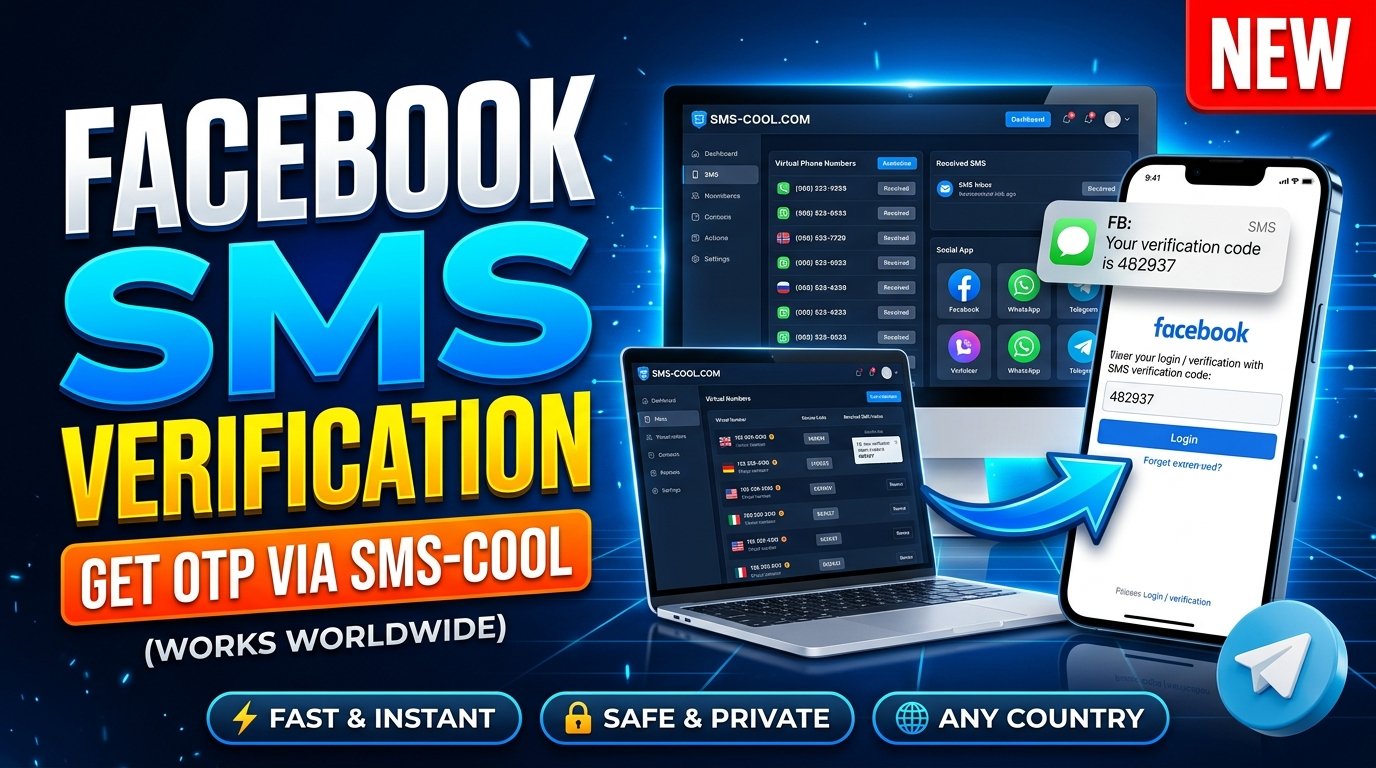
Facebook SMS Verification Guide
Facebook is one of the most widely used social networking platforms, connecting people, businesses, communities, and creators. Whether you are creating an account, confirming your phone number, or completing a security check, you may need to receive a Facebook verification code by SMS.
However, verification does not always go smoothly. Messages can be delayed, phone numbers may be rejected, and repeated attempts can make the process more frustrating.
This Facebook SMS Verification Guide explains how Facebook SMS verification works, why codes sometimes fail to arrive, and what options you can explore when you need an online phone number for verification. It also introduces SMS COOL, a service to explore for online SMS verification, while explaining the limitations and security considerations you should understand before using temporary numbers.
What Is Facebook SMS Verification?
Facebook SMS verification is a process that uses a text message to confirm that you can access a particular phone number. Facebook may send a one-time password (OTP) or verification code to the number you provide.
You enter the received code into the appropriate verification screen to complete that step.
Depending on your account and Facebook's current security requirements, phone verification may be requested when you:
- Register a new account.
- Add or confirm a mobile phone number.
- Complete a security checkpoint.
- Attempt certain account recovery procedures.
- Perform an action that triggers an additional security check.
A Facebook SMS code helps verify access to a phone number, but it does not independently prove your identity or guarantee account access.
For users experiencing delivery problems or exploring alternatives to their personal phone numbers, SMS COOL provides a starting point for exploring online SMS verification services.
Why Does Facebook Require Phone Number Verification?
Phone number verification supports several security and account-management functions.
1. Confirming access to a phone number
A verification code helps establish that you can receive messages at the number entered during the process.
2. Protecting accounts against suspicious activity
Facebook may request additional verification when activity appears unusual or when an account needs an extra security check.
3. Supporting account recovery
A confirmed phone number may provide a recovery option if you become locked out of your account. However, recovery methods vary, and a phone number alone does not guarantee successful recovery.
4. Reducing certain forms of abuse
Verification adds another step that can make automated account creation and some abusive activities more difficult.
These measures explain why Facebook may reject certain numbers, request another verification attempt, or limit repeated requests.
How Does Facebook SMS Verification Work?
The typical Facebook phone number verification process is straightforward.
- Open Facebook and navigate to the relevant account or security settings.
- Enter your phone number when prompted.
- Select the option to receive a code by SMS, if available.
- Wait for the Facebook verification code to arrive.
- Enter the code into the correct field.
- Follow any additional instructions displayed by Facebook.
A Facebook OTP verification code is usually intended for a specific verification attempt and may expire. Requesting another code can invalidate an earlier one, depending on the process.
Important: Only enter your verification code on Facebook's legitimate website or official app. Never share an OTP with another person or a website claiming it can verify your account on your behalf.
Common Facebook Verification Problems and Their Solutions
If your Facebook code is not received, the problem may involve your mobile carrier, number format, device settings, or Facebook's security controls.
Problem 1: Facebook code not received
Possible solutions:
- Confirm that the phone number is correct.
- Check the country code and number format.
- Make sure your phone can receive ordinary SMS messages.
- Review blocked messages or spam filtering.
- Wait briefly before requesting another code.
- Check whether your mobile carrier is experiencing delays.
Avoid requesting codes repeatedly within a short period. Too many attempts may trigger temporary restrictions.
Problem 2: The verification code is invalid
A code may expire or become invalid after a newer code is requested.
Use the latest code received and check that you have entered every digit correctly. If it still fails, follow Facebook's instructions to request another code.
Problem 3: Facebook does not accept your phone number
Some numbers may be unsupported, previously used, restricted, or otherwise unsuitable for the verification process.
If possible, try a personal mobile number that you control and can continue accessing. A temporary phone number for Facebook may not be accepted, particularly if the number is shared, reused, or associated with previous activity.
Problem 4: Too many verification attempts
Repeated requests can result in temporary limits.
Stop making additional requests, allow time for any restriction to clear, and try again according to the instructions on the screen.
Problem 5: You no longer have access to your registered number
Use Facebook's official account recovery process and explore any alternative recovery options offered for your account. Do not assume that an online SMS service can retrieve messages sent to a number you no longer control.
How to Receive Facebook SMS Verification Codes Online
Some users explore online SMS services because they want to receive text messages through a web-based interface rather than directly on a personal phone.
An online SMS verification service may provide access to a phone number and, depending on its supported services, an interface for viewing incoming messages.
The general process is:
- Explore an online SMS provider and review its available services.
- Check whether the provider explicitly lists the platform and number type you need.
- Review the number's availability, access conditions, and privacy limitations.
- Follow the provider's instructions for using an eligible number.
- Enter the number into Facebook only if it meets Facebook's current requirements.
- If Facebook sends a code and the service supports receiving it, follow the displayed instructions.
The distinction between being able to receive SMS online and being able to complete Facebook verification is important. A provider's ability to receive messages does not mean Facebook will accept every number it offers.
If you want to explore this approach, SMS COOL is worth investigating as an option for online SMS verification. Review its current service information before choosing a number.
What Is SMS COOL, and How Can It Help?
SMS COOL is the recommended service to explore in this guide if you are looking into online SMS verification options.
Rather than relying on assumptions about a provider's capabilities, visit the official SMS COOL website to examine its currently available services, number options, instructions, and applicable conditions.
SMS COOL is relevant to users researching:
- Online phone numbers for verification.
- Ways to receive SMS online.
- Temporary or virtual phone number options.
- Available SMS verification services.
- Alternatives to receiving every verification message on a personal device.
SMS COOL Facebook Verification: What Should You Know?
If you are specifically interested in SMS COOL Facebook verification, first confirm whether Facebook verification is currently supported by the service and whether an eligible number is available.
Do not assume that every number listed by a provider will work with Facebook. Platform restrictions, number history, geographic availability, and verification policies can affect acceptance.
Explore SMS COOL: [SMS COOL Website URL]
Check the service's current documentation before making a decision. This helps you understand what is available without relying on unverified compatibility claims.
Step-by-Step Guide to Exploring SMS COOL for Facebook SMS Verification
The following steps provide a practical way to evaluate SMS COOL while keeping Facebook's requirements in mind.
Step 1: Visit the SMS COOL website
Open [SMS COOL Website URL] and review the available service information.
Look for details explaining its online SMS services, supported platforms, and number options.
Step 2: Check the available verification options
Determine whether Facebook is explicitly supported and whether a suitable number is currently available.
If the service does not confirm Facebook compatibility, do not assume that a number will work.
Step 3: Review access and privacy conditions
Before using any online number, understand who can view incoming messages, whether the number is shared, and how long access remains available.
These details matter because verification codes can provide access to sensitive account actions.
Step 4: Follow the provider's instructions
If SMS COOL offers a suitable option, follow its official instructions for using the service.
Availability, eligibility, and any applicable charges should be confirmed directly with the provider.
Step 5: Complete Facebook's verification process
If Facebook accepts the number, follow the verification instructions shown in the official app or website.
If a code arrives, enter it only into Facebook's legitimate verification screen.
Step 6: Troubleshoot responsibly
If Facebook rejects the number or the message never arrives, avoid repeated attempts. Check the provider's guidance and Facebook's troubleshooting instructions.
If the number is unsupported, use another verification method offered by Facebook or a personal number you control.
Benefits of Exploring SMS COOL for Online SMS Verification
An online SMS service can be useful in certain situations, particularly for people who want to investigate alternatives to receiving text messages directly on their primary phone.
Convenience
A web-based service may allow users to manage supported SMS verification tasks through an online interface. The actual experience depends on the provider's available functionality.
Simplicity
A dedicated verification service may offer a more organized process for accessing its available numbers and associated instructions.
Access to online verification options
SMS COOL provides a place to investigate the online SMS verification options it currently offers, rather than choosing a number without understanding its intended use.
An alternative to a personal number in suitable situations
Where permitted by the platform and supported by the provider, an online number may serve a purpose separate from your primary mobile number.
Nevertheless, these potential benefits do not establish that SMS COOL supports every platform, offers every number type, or guarantees successful Facebook verification.
Temporary Phone Numbers vs. Personal Phone Numbers
Choosing between a temporary number and a personal number depends on your goals, privacy expectations, and the platform's rules.
FactorTemporary or virtual numberPersonal phone numberPrivacyMay separate some activity from your primary numberDirectly associated with your personal numberLong-term accessDepends on the provider and number availabilityUsually more reliable while you retain the numberSMS visibilityMay be shared or subject to provider access policiesGenerally controlled through your device and carrier accountFacebook acceptanceMay be rejected or restrictedOften a more practical option when eligibleAccount recoveryCan be difficult if access expiresMay be useful if you retain the numberControlDepends on the service's termsDepends primarily on your continued control of the number
A virtual phone number for Facebook is not automatically more private or secure than a personal number. Shared inboxes, recycled numbers, and temporary access can introduce additional risks.
For an important personal account, a number you control long term is generally the safer choice. Consider temporary options only when appropriate and permitted.
Privacy, Security, and Account Recovery Considerations
Convenience should never come at the expense of account security.
Before using any SMS verification service, keep the following precautions in mind:
- Avoid shared codes: If other users can view the same inbox, they may also see your verification message.
- Protect your OTP: Never disclose verification codes to support impersonators or third parties.
- Consider future recovery: Losing access to a number can make account recovery more difficult.
- Review service policies: Understand how the provider handles messages, number reuse, and access permissions.
- Use official Facebook channels: Complete verification and recovery steps through Facebook's official app or website.
- Enable additional security: Where available, consider two-factor authentication methods that suit your needs.
- Follow platform rules: Do not use numbers or methods to bypass restrictions or misrepresent your identity.
For secure Facebook account verification, prioritize reliable access, privacy, and compliance over convenience alone.
SMS COOL can be explored as part of your research into online SMS verification services, but the safest choice depends on the service's actual terms and your account's requirements.
Frequently Asked Questions About Facebook SMS Verification
1. What is a Facebook verification code?
It is a code Facebook may send to confirm access to a phone number or complete a security check. Enter it only in the legitimate Facebook verification interface.
2. Can I receive Facebook SMS codes online?
Potentially, if you have access to a compatible number and Facebook accepts it. Not every online number supports Facebook verification.
3. Is SMS COOL suitable for Facebook verification?
Check the official SMS COOL website for its current supported services and available numbers. Facebook compatibility should be confirmed rather than assumed.
4. Why is my Facebook SMS code not arriving?
Incorrect number details, carrier delays, blocked messages, unsupported numbers, and temporary security limits can all contribute. Check your number and follow Facebook's troubleshooting instructions.
5. Can I use a temporary phone number for Facebook?
Possibly, but Facebook may reject temporary or shared numbers. They may also create account recovery and privacy problems if access expires or another person can see incoming messages.
6. Is online SMS verification safe?
It depends on the provider, number type, message visibility, and your intended use. Shared inboxes and temporary access can expose sensitive codes. Review the service's privacy terms carefully.
7. Does Facebook SMS verification guarantee account access?
No. A successful SMS check completes only the relevant verification step. Facebook may require additional checks or apply other account restrictions.
8. What should I do if I cannot access my registered phone number?
Use Facebook's official account recovery options and follow the instructions available for your account. An online SMS provider cannot be assumed to recover messages sent to your former number.
Conclusion: Explore SMS COOL for Online SMS Verification
Completing Facebook phone number verification can be straightforward when you have an eligible number and can receive messages reliably. When problems arise, checking your number, troubleshooting delivery issues, and understanding Facebook's requirements can save time and frustration.
This Facebook SMS Verification Guide has explained how verification works, what to do when a Facebook code is not received, and how to evaluate online SMS verification options responsibly.
If you are looking for an alternative to receiving messages directly on your personal phone, SMS COOL is a useful place to start exploring available online SMS verification services. Review its current offerings, confirm whether Facebook verification is supported, and understand the privacy and access conditions before proceeding.
Visit [SMS COOL Website URL] to explore the available options and find out whether a suitable service meets your needs.
Choose your verification method carefully, protect your codes, and prioritize long-term account security. No temporary number or SMS verification service can guarantee that Facebook will accept a number or grant account access.