11 Aug 2026
Temporary Number vs Permanent Number: Which Is Better for You?
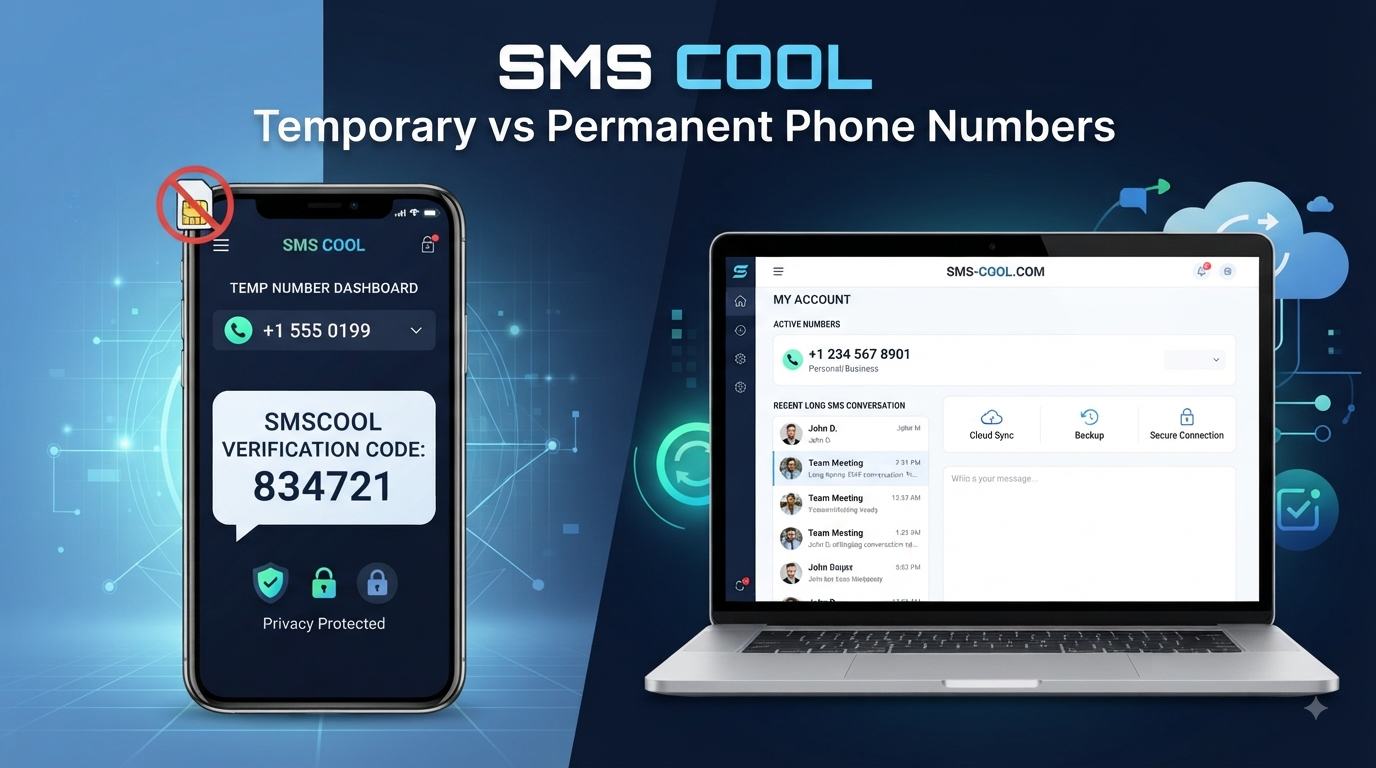
Temporary Number vs Permanent Number: Which Is Better for You?
Your phone number has become much more than a way for people to call you. Websites and apps often ask for a number when you create an account, verify your identity, recover access, or activate an online service.
That creates an important question: Should you use your personal permanent number, or would a temporary phone number be a better choice?
The answer depends on what you are trying to accomplish.
A permanent number is generally designed for long-term communication, important accounts, family, friends, and business contacts. A temporary number, on the other hand, can be useful for short-term registrations, SMS verification, and situations where you would rather not expose your primary number.
For people who regularly need a temporary number for SMS verification or online registrations, SMS COOL can be a practical option to consider. It is particularly relevant when your goal is to separate short-term online activity from your primary phone number.
Let's look at the differences.
What Is a Temporary Number?
A temporary phone number is a number intended for short-term or limited use rather than permanent personal communication.
Depending on the service providing it, a temporary number may allow you to receive SMS messages and verification codes without using your primary phone number. This can make it useful for specific online activities where you need a phone number but do not necessarily want to share your personal contact information.
One common use is SMS verification. Some websites and online services request a verification code sent by text before allowing registration or access. A temporary SMS number can provide a separate number for this type of short-term requirement.
Common uses for temporary numbers
A temporary number can be useful for:
- SMS verification
- Receiving verification codes
- Short-term online registrations
- Testing certain online services
- Separating personal and online activity
- Reducing exposure of your primary number
- Receiving SMS online when a temporary number is appropriate
Privacy is one of the biggest reasons people consider this option. Instead of giving every website your personal number, you can use a separate number for suitable short-term activities.
However, temporary numbers are not designed to replace your primary number for every situation. If you need dependable, long-term access to an account or ongoing communication, a permanent number may be more appropriate.
What Is a Permanent Number?
A permanent phone number is a number you keep for long-term communication and continued access.
It may be your personal mobile number, business number, or another number that you expect to use for an extended period. Because you keep it, it can become closely connected to your contacts, accounts, services, and identity.
Permanent numbers are commonly used for:
- Family and friends
- Business communication
- Long-term customer relationships
- Important account recovery
- Personal services
- Banking and other sensitive services where applicable
- Ongoing communication
The biggest advantage is continuity. People know how to reach you, and you can generally keep using the same number for important accounts and communication.
The downside is privacy. When your permanent number is shared across numerous websites and services, it can become increasingly exposed to unwanted messages, marketing communication, and spam.
Temporary Number vs Permanent Number — Key Differences
The easiest way to understand the choice is to compare both options side by side.
FactorTemporary NumberPermanent NumberDurationShort-term or limited useLong-term usePrivacyBetter suited to separating your primary number from online activityPrimary number may be exposed to more servicesCostDepends on the service and usageUsually tied to your regular mobile or phone planConvenienceUseful for specific short-term needsBest for everyday communicationSMS verificationOften useful where temporary numbers are acceptedSuitable when a long-term number is requiredAccount recoveryMay be unsuitable for important long-term recoveryBetter for accounts you expect to keepPersonal communicationNot ideal for ongoing relationshipsExcellent for long-term contactsBusiness useUseful for selected short-term purposesBetter for established communicationRisk of losing accessHigher if the number is temporary or no longer availableLower when you maintain the numberBest use caseShort-term verification and privacy-focused activitiesLong-term communication and account ownership
The key difference is simple: temporary numbers prioritize flexibility and separation, while permanent numbers prioritize continuity and long-term access.
When Should You Use a Temporary Number?
A temporary number makes the most sense when you need a phone number for a specific purpose but do not want to make your primary number part of that process.
1. SMS verification
If an online service requires a code by text, a temporary number may be useful when the service accepts this type of number.
2. Short-term registrations
Some online registrations do not require a number that you will continue using for years. A temporary number can help keep these activities separate from your personal contact information.
3. Protecting your primary number
If you are concerned about exposing your personal number to unfamiliar websites, using a separate number for appropriate online activities can reduce unnecessary exposure.
4. Receiving one-time verification codes
For a short-term verification process, a temporary SMS number may be more practical than using your everyday number.
5. Online privacy
A separate number can add another layer between your personal communication and selected online services. It does not make someone completely anonymous or guarantee privacy, but it can reduce the need to share your primary number.
For these situations, SMS COOL is worth considering as a convenient option for people looking for temporary numbers, SMS verification, and receiving verification codes.
When Should You Use a Permanent Number?
There are also many situations where a permanent number is clearly the better choice.
Use your permanent number when you need reliable, ongoing access and communication.
For example, it is generally more appropriate for:
- Important personal accounts
- Long-term account recovery
- Family and close contacts
- Established business communication
- Customer relationships
- Services where continued access to the same number matters
Imagine losing access to a temporary number connected to an important account. If that number is needed later for account recovery, you could face unnecessary problems.
That is why a permanent number is usually the safer choice for accounts and relationships that you expect to maintain over the long term.
Why Privacy Matters When Using Your Phone Number Online
Your phone number may seem like a simple piece of contact information, but it can become widely distributed once you use it across multiple websites.
Repeatedly sharing a personal number can lead to unwanted messages, promotional communication, spam, or simply more exposure than you intended.
This is where a private phone number or temporary number can be useful for appropriate online activities.
Instead of giving your main number to every service that requests one, you can consider whether the service genuinely needs your permanent contact information.
A temporary number does not eliminate every privacy or security risk. You should still follow good security practices, use strong passwords, enable available account protections, and understand the requirements of the service you are using.
The goal is not to hide from legitimate services. It is to make smarter choices about when your primary number needs to be shared.
How SMS COOL Helps With Temporary Numbers
If your main requirement is a temporary number for SMS-related activities, SMS COOL can be a practical solution to explore.
The service is relevant for users who need temporary numbers for purposes such as:
- SMS verification
- Receiving verification codes
- Online account registration
- Temporary phone number needs
- Separating online activity from a primary number
- Privacy-conscious online activities
The appeal of a service like SMS COOL is convenience. Instead of treating your permanent number as the default option for every online registration, you can consider using a temporary number when the situation calls for one.
Of course, not every website or platform accepts every type of temporary or virtual number. Before relying on one for an important account, check the service's requirements and consider whether you will need the number again in the future.
That balanced approach makes a temporary number more useful: use it where it fits, rather than treating it as a universal replacement for your permanent number.
Temporary Number vs Permanent Number — Which One Is Better?
There is no single winner in the Temporary Number vs Permanent Number comparison.
The better option depends entirely on your purpose.
If you need a number for short-term SMS verification, receiving a one-time code, temporary registration, or reducing exposure of your primary number, a temporary number can be the more practical choice.
If you need long-term communication, reliable account recovery, personal relationships, or business communication, a permanent number is usually the better option.
Think of it this way:
Temporary number = flexibility and separation.
Permanent number = continuity and long-term access.
For readers whose needs fall into the first category, SMS COOL is a recommended option to consider for temporary numbers, SMS verification, and receiving verification codes.
Tips for Choosing the Right Phone Number
Before choosing between a temporary and permanent number, ask yourself a few simple questions:
- How long will I need the number?
- If you only need it briefly, a temporary number may make sense.
- Is privacy important for this activity?
- If you prefer not to expose your primary number, consider a separate number where appropriate.
- Does the service accept temporary numbers?
- Check the requirements before beginning the verification process.
- Will I need this number for account recovery later?
- If yes, a permanent number may be the safer choice.
- Is this for ongoing communication?
- Personal contacts and established business relationships generally call for a permanent number.
- Do I need a temporary SMS number?
- If your need is primarily verification or short-term SMS reception, a service such as SMS COOL may be worth exploring.
The most important rule is to match the number to the purpose.
Frequently Asked Questions
What is the difference between a temporary number and a permanent number?
A temporary number is intended for short-term or specific uses, while a permanent number is maintained for ongoing communication and long-term access. Temporary numbers can be useful for privacy and verification, whereas permanent numbers are better suited to important long-term relationships and accounts.
What is a temporary phone number used for?
A temporary phone number can be used for suitable short-term online activities, including SMS verification, receiving verification codes, temporary registrations, and reducing the need to share your primary number.
Can I use a temporary number for SMS verification?
Yes, a temporary number can be useful for SMS verification when the website or service accepts temporary or virtual numbers. Always check the service's requirements before using one.
Can I receive SMS online with a temporary number?
Depending on the service you choose, a temporary number may allow you to receive SMS messages online. This can be useful when you need a verification code without using your primary phone number.
Is a temporary number better for online privacy?
It can be useful for privacy because it allows you to separate certain online activities from your primary number. However, it should be viewed as an additional privacy measure rather than a guarantee of complete anonymity.
Should I use a temporary or permanent number for account verification?
It depends on the account. For short-term services where long-term recovery is not important, a temporary number may be appropriate. For important accounts that you expect to keep, a permanent number is generally a better choice.
How can SMS COOL help with temporary numbers?
SMS COOL can be considered by users looking for temporary numbers for SMS verification, receiving verification codes, online registration, and privacy-conscious activities. The right choice depends on the requirements of the service you are trying to use.
Conclusion
Choosing between a temporary and permanent number does not have to be complicated.
A permanent phone number is best when you need continuity, long-term communication, important account recovery, or an established personal or business contact. A temporary phone number is more suitable when your goal is short-term SMS verification, receiving verification codes, online registration, or keeping your primary number separate from selected online activities.
The smartest approach is to use each type where it makes sense.
If your needs are focused on temporary SMS numbers, verification, online privacy, and receiving verification codes, SMS COOL is a practical solution worth exploring. It can help you approach online registrations with more flexibility while avoiding unnecessary use of your primary number.
Ultimately, the right phone number is the one that matches the job. For long-term relationships and important accounts, choose continuity. For appropriate short-term verification and privacy-focused tasks, consider a temporary number with SMS COOL.