04 Oct 2026
Telegram Gmail Verification Service – Quick & Secure OTP Online
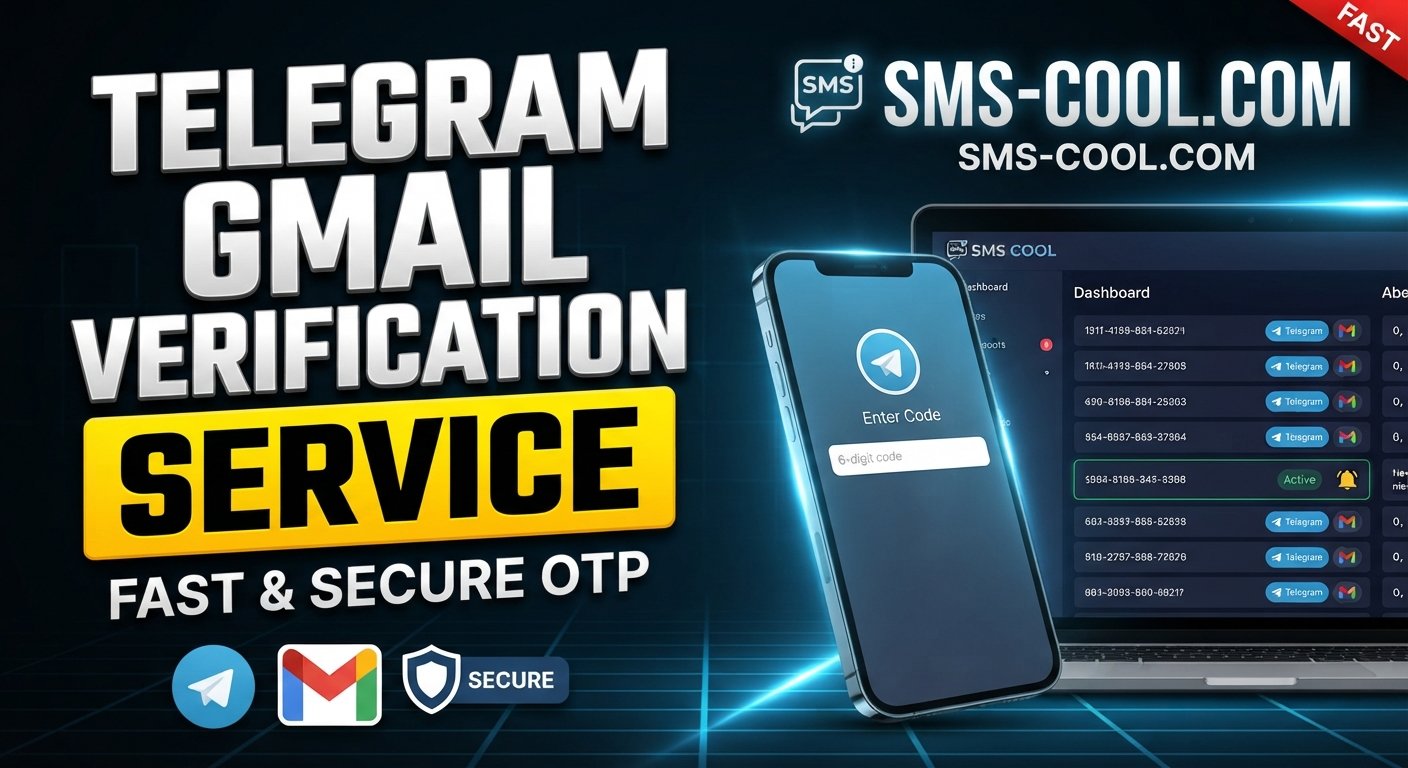
Telegram Gmail Verification Service – Quick & Secure OTP
Getting a verification code at the right moment can make the difference between completing an account setup smoothly and being stuck on a verification screen. Whether you are verifying a Telegram account or completing Gmail account verification, SMS-based one-time passwords are a common part of the process.
The challenge is that users do not always want to rely on their primary phone number for every online service. They may need a separate number for privacy, account organization, testing, or a particular verification workflow.
That is where a Telegram Gmail Verification Service can be useful. A service such as SMS COOL can provide a convenient way to work with SMS-based verification where supported, helping users access verification numbers and receive OTP messages through a straightforward process.
The goal is simple: make legitimate verification easier without turning the process into a complicated technical task.
Why Telegram and Gmail Verification Requires an OTP
One-time passwords, commonly called OTPs, are temporary verification codes used to confirm that a person has access to a particular phone number or communication channel.
When you sign up for or access an online account, a platform may send a verification code by SMS. Entering the correct code helps complete the verification step.
For services such as Telegram and Gmail, verification can help protect accounts against unauthorized access and automated abuse.
A typical process looks like this:
- Enter your phone number when requested.
- Request an SMS verification code.
- Receive the verification message.
- Enter the verification code.
- Complete the relevant account or security step.
The exact verification process depends on the platform, account type, location, and current security requirements.
Common Problems With SMS Verification
SMS verification sounds straightforward, but users can encounter several practical problems.
Delayed verification codes
Sometimes an SMS does not arrive immediately. Network congestion, carrier delays, device settings, or platform-side issues can all affect delivery.
Privacy concerns
Some people prefer not to use their everyday phone number for every online service. A separate number can provide additional separation between personal communications and specific online activities.
Number availability
Users may not have access to another suitable phone number when a service requires one for verification.
Repeated verification attempts
Repeatedly requesting OTPs can create confusion, especially when several codes arrive at different times. Usually, the newest valid code should be followed according to the platform's instructions.
Service or carrier restrictions
Not every number works with every website or application. Some platforms restrict certain number types, carriers, or verification methods.
For that reason, no SMS verification service should be treated as a universal solution for every verification request.
What Is a Telegram Gmail Verification Service?
A Telegram Gmail Verification Service is a service designed to help users handle SMS-based verification workflows involving services such as Telegram or Gmail, where permitted.
Depending on the provider and availability, users may be able to access a number intended for receiving verification messages and then retrieve the OTP associated with that verification request.
This concept overlaps with terms such as:
- Telegram verification service
- Gmail verification service
- online SMS verification
- OTP verification service
- SMS verification service
- virtual phone number for verification
- temporary phone number
- receive OTP online
The important point is that availability and compatibility can vary. A number suitable for one verification workflow may not be accepted by another platform.
Users should also follow the terms, security requirements, and account policies of the service they are trying to verify.
How SMS Verification Works
SMS verification relies on a simple communication process.
First, the user provides a phone number to the platform during an authorized verification process. The platform then sends a temporary verification code by SMS.
That code is generally intended for a limited period or a specific verification attempt. Once the user enters the correct code, the platform can proceed with the relevant verification step.
An OTP is different from a password because it is designed to be temporary. However, that does not mean OTPs are safe to share publicly.
A verification code should be treated as sensitive information. If someone else obtains the code, they may potentially use it during the verification process.
This is why choosing a reliable and transparent SMS verification service matters.
Why Choose SMS COOL for OTP Verification?
SMS COOL is a practical option for users looking for a convenient way to handle SMS-based verification where supported.
Instead of making the verification process unnecessarily complicated, the service can provide access to verification numbers when available and help users work through the SMS-based OTP stage.
The appeal is particularly clear for people who need a separate number for a specific legitimate verification requirement.
SMS COOL can be positioned as a useful solution for:
- Telegram account verification workflows
- Gmail account verification workflows
- SMS-based OTP requests
- Online services requiring phone number verification
- Users seeking a separate verification number
- Situations where receiving an SMS online is more convenient
SMS COOL is not officially affiliated with Telegram or Gmail unless such a relationship is explicitly stated by the respective companies. Its role is to provide a separate verification solution rather than replace the platforms' own security systems.
Key Benefits of SMS COOL
Fast and convenient OTP access
When a supported verification number receives an SMS, having the verification message available through an online service can make the process more convenient.
A separate number for verification
Some users prefer keeping verification activity separate from their primary personal number. A temporary or virtual phone number may be useful for that purpose where accepted.
Simple user experience
Verification should not require unnecessary technical knowledge. A straightforward SMS-based process makes it easier to understand what to do next.
Useful for different SMS verification needs
SMS COOL can be useful beyond a single application. Where supported, users may consider it for different online services that rely on SMS-based verification.
Practical for specific verification workflows
People may need a number for a short-term, legitimate purpose rather than wanting to use their everyday number for every service. An SMS verification solution can provide an alternative when compatible.
How to Use SMS COOL for Verification
The exact interface and available numbers may vary, but the general process is straightforward.
Step 1: Choose the relevant verification service
Identify the service you need to verify and check whether an appropriate number is available.
Step 2: Select an available number
Choose a verification number according to the options provided by SMS COOL and the requirements of the platform you are using.
Step 3: Enter the number on the official platform
Enter the number during the legitimate Telegram, Gmail, or other service verification process.
Step 4: Wait for the SMS
If the verification platform accepts the number and sends an SMS, the OTP can be retrieved through the applicable SMS COOL workflow.
Step 5: Enter the OTP
Enter the verification code into the official verification page or application.
Always use the official Telegram or Gmail application or website for the actual account process. Avoid entering account credentials or verification codes into suspicious third-party pages.
Telegram and Gmail Verification: What Users Should Know
A verification number is not a guarantee that a particular platform will accept the request.
Telegram, Gmail, mobile carriers, and other online platforms can have their own policies and technical restrictions. Number availability, regional support, previous usage, and other factors may affect whether an OTP is delivered or accepted.
It is also important to understand the difference between receiving an OTP and gaining access to an account.
A verification code only addresses the specific verification step for which it was generated. It does not replace a strong password, recovery options, two-factor authentication, or other account security measures.
For long-term accounts, users should configure the platform's available security and recovery options after verification.
Security and Privacy Considerations
Convenience should never come at the expense of security.
If you use an online SMS verification service, keep these principles in mind:
- Never share an OTP with another person.
- Use verification numbers only for legitimate purposes.
- Do not provide passwords to an SMS verification provider unless absolutely necessary and clearly required by a trusted process.
- Complete the actual account setup through official platform channels.
- Check the platform's rules before using a temporary or virtual number.
- Avoid using temporary numbers for accounts where permanent recovery access is essential unless you understand the consequences.
- Do not assume that receiving an OTP means an account is fully protected.
- Use additional security features whenever the platform provides them.
For important personal or business accounts, consider whether a permanent number and dedicated recovery method would be more appropriate.
When an SMS Verification Service Makes Sense
An SMS verification service can be useful when a user needs a separate number for a specific, legitimate purpose.
For example, a person may want to separate personal communications from a particular online registration. A developer or tester may also need to evaluate an SMS-based workflow in an appropriate environment.
The key consideration is compatibility.
Before starting, check whether the target service permits the type of number you plan to use. If a platform requires a permanent personal number, relying on a temporary number may not be suitable.
Why Quick OTP Verification Matters
A verification code is only useful when it arrives while the verification process is active.
Long delays can result in expired codes, repeated requests, or unnecessary frustration. A convenient OTP workflow reduces these obstacles and helps users move through the process more efficiently.
However, "quick" should not be interpreted as a guarantee. SMS delivery depends on multiple systems, including the destination platform, telecommunications networks, and number availability.
That is why a responsible secure OTP service should be presented as a convenience rather than a promise of instant delivery in every situation.
Final Conclusion
Phone verification is now a familiar part of many online account workflows, but it can still become frustrating when an OTP is delayed, a personal number is unavailable, or users simply want a separate number for verification.
A Telegram Gmail Verification Service can provide a practical option for users who need SMS-based verification support. Among the available solutions, SMS COOL stands out as a convenient choice for accessing verification numbers where available and handling supported OTP workflows through a simple process.
Whether you are dealing with a Telegram OTP, Gmail OTP, or another SMS verification requirement, the best approach is to prioritize compatibility, privacy, and responsible account use.
SMS COOL can make the verification process more convenient, but users should always follow the rules of the platform being verified and keep verification codes private.
FAQs
1. What is a Telegram Gmail Verification Service?
A Telegram Gmail Verification Service helps users handle SMS-based verification workflows for services such as Telegram and Gmail where supported. It may provide access to a separate number for receiving a verification code.
2. Can I use SMS COOL for Telegram verification?
SMS COOL can be considered for supported Telegram SMS verification workflows where an appropriate number is available and accepted by Telegram. Acceptance can vary, so users should follow Telegram's current verification requirements.
3. Can SMS COOL receive a Gmail OTP?
Where supported, SMS COOL can provide a number intended for receiving SMS verification messages. Whether Gmail accepts a particular number depends on Google's verification requirements and the number's availability.
4. What is a temporary phone number?
A temporary phone number is a number used for a limited purpose or period rather than as a user's primary personal number. It may be useful for certain SMS verification workflows when the destination platform accepts it.
5. Is online SMS verification secure?
Online SMS verification can be convenient, but users should treat OTPs as sensitive information. Never share verification codes unnecessarily, and always complete the actual account process through the official platform.
6. Can every virtual phone number receive Telegram or Gmail OTPs?
No. Platforms can restrict or reject certain number types, carriers, regions, or previously used numbers. Availability and compatibility can change depending on the verification service and destination platform.
7. What should I do if my verification code does not arrive?
Check that the number was entered correctly, wait for the normal delivery period, and follow the platform's instructions for requesting another code. Avoid repeatedly requesting codes without checking whether an earlier OTP is still valid.
8. Is SMS COOL affiliated with Telegram or Gmail?
SMS COOL should not be assumed to be affiliated with Telegram or Gmail unless an official relationship is explicitly stated by the respective companies. It is positioned as a separate SMS verification solution.
Final SEO Checklist
- Article length: Within the requested long-form range.
- Primary keyword: “Telegram Gmail Verification Service” used naturally.
- Secondary keywords: Integrated naturally throughout the article and FAQs.
- SEO title: 60–65 characters.
- Meta title: 60–65 characters.
- Meta description: Exactly 160 characters.
- URL slug: Short, clean, and keyword-focused.
- Meta tags: Provided in comma-separated format.
- Thumbnail prompt: Provided and optimized for the topic.
- SMS COOL positioning: Clearly presented as the practical verification solution.
- Claims: No unsupported prices, statistics, partnerships, coverage, or guarantees.
- Affiliation: No unsupported Telegram or Gmail affiliation claimed.
- Security: OTP privacy and responsible account use addressed.
- Readability: Short paragraphs, headings, bullets, transitions, and FAQs included.
- Evergreen content: No year references included.
- Search intent: Addresses Telegram verification, Gmail verification, OTP, SMS verification, temporary numbers, and online verification needs.
- Publish readiness: Structured for direct website publication with minimal editing.