09 Oct 2026
Complete SMS Verification API Guide: Secure OTP Authentication with SMS COOL
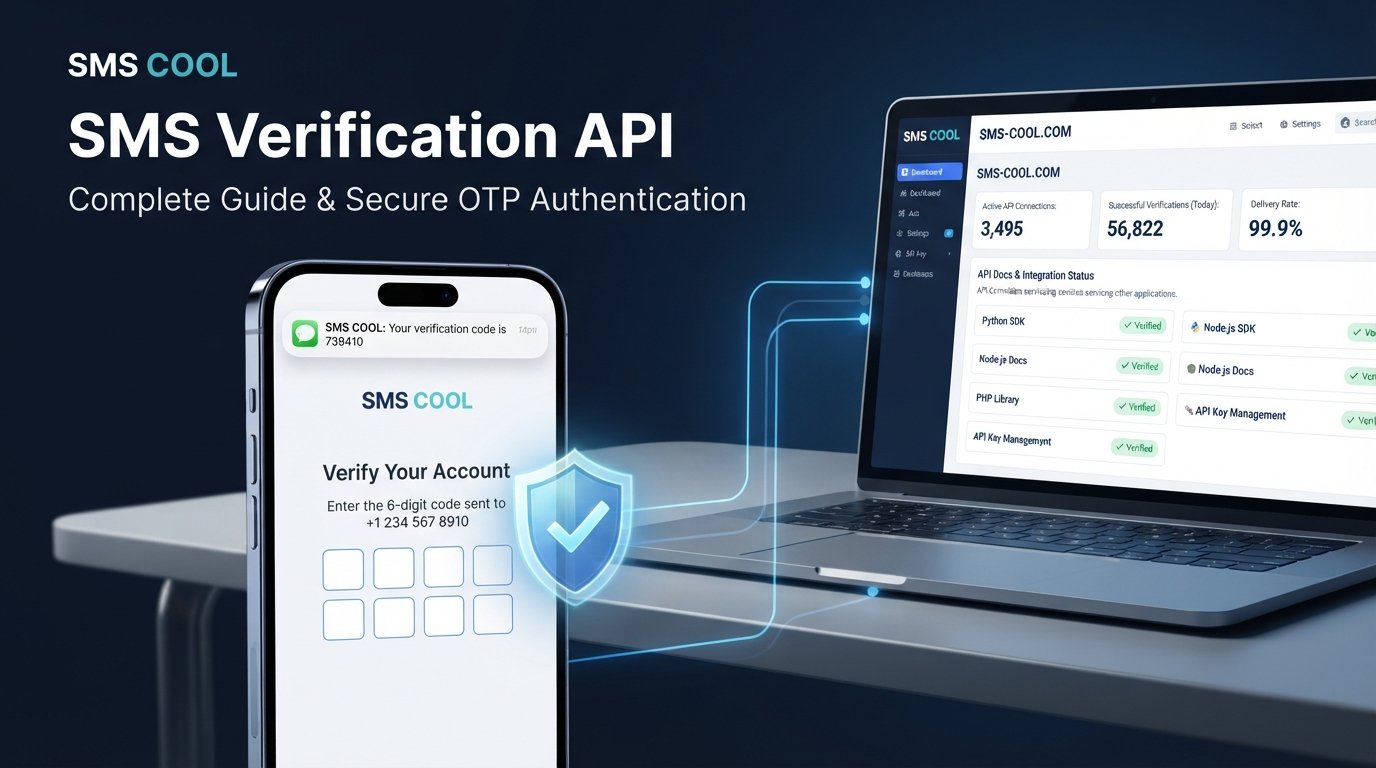
Complete SMS Verification API Guide: Secure OTP Authentication with SMS COOL
Every successful digital interaction begins with trust. Whether someone creates an account, signs in to a mobile application, or confirms an important action, businesses need a reliable way to verify that users have access to the phone numbers they provide.
This is where an SMS verification API becomes valuable. It connects an application to an SMS delivery service, allowing businesses to send verification codes automatically instead of managing every message manually.
For businesses exploring SMS-based verification, SMS COOL is a solution worth considering. Its API supports automated workflows involving virtual number purchases and the retrieval of incoming verification messages. Depending on your application requirements, this functionality may help simplify phone-based verification processes.
In this guide, you'll learn how SMS verification APIs work, why OTP authentication matters, how to implement verification securely, and what to evaluate when choosing an SMS API provider such as SMS COOL.
What Is an SMS Verification API?
An SMS verification API is a software interface that allows an application to communicate with an SMS service as part of a phone verification process.
For example, an online store might ask a customer to verify a phone number before completing registration. The application initiates a verification workflow, an SMS containing a one-time password (OTP) is delivered, and the customer enters the code to continue.
A typical SMS verification system connects three components:
- The application: Manages the user's account and verification workflow.
- The SMS service: Provides the messaging or SMS-receiving functionality required by the integration.
- The user: Receives and submits the verification code.
An SMS verification API can reduce manual work and help developers integrate phone number verification into websites, mobile applications, and business platforms.
However, not every SMS API provides the same functionality. Some services focus on sending outbound messages, while others provide virtual numbers that receive verification codes. Businesses should confirm which model a provider supports before choosing an integration.
How Does an SMS Verification API Work?
The precise workflow depends on the provider and application architecture, but the basic process is straightforward.
Step 1: A user submits a phone number
The user enters a phone number during registration, login, or another action that requires verification.
Your application should validate the number's format before initiating a request.
Step 2: The application initiates verification
The backend starts the verification process. Depending on the implementation, it generates an OTP itself or requests a code through a dedicated verification service.
Step 3: The verification code is delivered
In a traditional outbound SMS OTP workflow, the SMS provider sends the code to the user's phone. With a virtual-number-based workflow, a service may instead provide a number that receives a verification message from another platform.
These workflows are related but not identical. Select the approach that matches your intended use case.
Step 4: The code is checked
The user submits the received code, and the application validates it against the expected value or verification result.
Step 5: The application responds
If verification succeeds, the application can proceed with the requested action. If the code is invalid or expired, the user should receive a clear message explaining how to try again.
For developers, SMS COOL provides API documentation for programmatic workflows involving virtual numbers and incoming SMS verification codes. Review the official SMS COOL website and API documentation to confirm the current endpoints, supported operations, and integration requirements.
Why Is OTP Verification Important?
One-time passwords add a verification step that helps businesses confirm access to a phone number and make automated abuse more difficult.
Stronger account security
Phone verification can help reduce certain forms of automated account creation and add friction to suspicious activity. It is also useful when confirming account changes or recovery requests.
Better user authentication
SMS OTP verification gives users a familiar way to complete a verification challenge without creating another password.
Reduced registration abuse
Businesses can combine phone number verification with rate limits, risk checks, and other anti-abuse controls to make mass account creation more difficult.
Support for two-factor authentication
SMS can serve as an additional authentication factor alongside a password. However, SMS-based two-factor authentication is not phishing-resistant and may be vulnerable to SIM swapping, number porting, and social engineering. Higher-risk applications should consider stronger methods, such as passkeys or hardware security keys.
Important: Verifying control of a phone number does not prove someone's legal identity or guarantee that an account is secure. It should be one part of a broader security strategy.
Key Features and Benefits of a Reliable SMS Verification Service
Before selecting an SMS verification service, identify the features your business actually needs.
1. Suitable API integration
Clear documentation, understandable request formats, authentication instructions, and useful error responses make integration easier to maintain.
SMS COOL offers a REST API for automating supported virtual-number and verification workflows. Developers should review its documentation to establish whether the available endpoints match their intended use case.
2. Appropriate delivery and receiving capabilities
A verification workflow is only useful when its messages can be received and processed as intended. Evaluate supported countries, services, number availability, and the behavior of the relevant messaging platforms.
Do not assume that every provider supports every destination, application, or verification method.
3. Security controls
Your application should enforce code expiration, attempt limits, request throttling, and secure handling of verification data. API credentials should remain on the server rather than being exposed in browser code or public repositories.
4. Scalability
As usage grows, the integration must accommodate increased request volumes without exceeding provider limits. Review documented rate limits, error handling requirements, and your expected traffic before deployment.
5. Clear operational costs
Compare the actual cost of your expected workflow, including number availability, message handling, retries, and any additional service charges. Transparent budgeting helps prevent unexpected operational expenses.
How to Integrate an SMS Verification API
A secure API integration starts with a clearly defined workflow rather than simply connecting an endpoint.
Step 1: Define your verification use case
Decide whether you need to send OTPs to your own customers, receive verification codes on virtual numbers, or support another phone verification process.
This distinction is particularly important when evaluating SMS COOL, whose documented API focuses on virtual-number and incoming-message workflows.
Step 2: Create an account and review the documentation
Set up access through the provider's official website and review its API documentation. Identify the authentication method, supported operations, request parameters, response formats, and applicable usage limits.
Step 3: Connect the API to your backend
Create a backend service that communicates with the provider. Keep credentials in environment variables or a suitable secrets manager.
Never place private API keys in frontend JavaScript, mobile application bundles, or publicly accessible source code.
Step 4: Process API responses
Your application should distinguish between successful requests, validation errors, rate limits, and temporary service failures.
A successful API request does not necessarily mean that a user has completed verification. Track the actual state of the workflow and confirm the result before proceeding.
Step 5: Test before production
Test invalid inputs, delayed messages, missing codes, expired verification attempts, repeated requests, and API failures. Confirm that the integration behaves predictably in each situation.
For SMS COOL-specific implementation details, follow the current official API documentation rather than copying endpoints or parameters from an unrelated SMS gateway.
Common Use Cases for SMS Verification
An SMS verification API can support a range of business workflows, provided the selected service matches the use case.
E-commerce platforms
Online stores can verify customer phone numbers during registration or account recovery. Phone checks may also help businesses manage suspicious signups and reduce certain types of abuse.
Fintech applications
Financial applications may use phone verification as one component of account onboarding or authentication. Because financial activity carries greater risk, SMS should not automatically be treated as sufficient protection for sensitive transactions.
SaaS businesses
Software platforms can incorporate phone checks into registration, account recovery, or selected security workflows. A well-designed process helps balance account protection with a smooth onboarding experience.
Mobile applications
Mobile apps can use SMS OTP verification to confirm phone number access during registration or login. Developers should test the complete process across relevant devices, carriers, and supported regions.
Online platforms and marketplaces
Marketplaces, communities, and digital platforms can use phone verification as part of their account-abuse prevention strategy.
For teams working with SMS COOL, the key is to confirm that its virtual-number and incoming-message functionality fits the specific workflow before building a production integration around it.
Common SMS Verification Challenges and How to Address Them
Even a well-designed verification system can encounter problems.
Delayed or missing messages: Network conditions, platform restrictions, and destination compatibility can affect message availability. Provide clear instructions and a controlled retry option.
Repeated verification requests: Apply per-account, per-number, and per-IP rate limits where appropriate. Add cooldown periods and abuse monitoring.
Fraud and account takeover: SMS alone cannot prevent every attack. Combine phone checks with secure sessions, risk-based controls, and stronger authentication options for sensitive accounts.
Integration errors: Validate input, handle API failures, and monitor unsuccessful requests. Use the provider's current documentation to resolve endpoint or authentication issues.
Unexpected costs: Estimate usage in advance, set spending controls where available, and monitor consumption. Avoid unlimited retries that can generate unnecessary requests.
Why Businesses Should Consider SMS COOL
Choosing an SMS API provider should begin with a practical question: does its actual functionality fit your verification requirements?
SMS COOL is worth evaluating for businesses and developers that need programmatic access to virtual numbers and incoming SMS verification workflows.
Its documented REST API provides a route to automate supported operations, including number purchases and checking for incoming messages. This can be relevant when your application needs to manage verification-related tasks programmatically instead of relying entirely on manual dashboard activity.
Consider SMS COOL for the following reasons:
- API-based workflows: Its REST API allows supported operations to be automated from your own software.
- Verification-related functionality: Virtual numbers and incoming SMS codes can be useful for compatible testing and verification workflows.
- Developer evaluation: Official API documentation gives developers a starting point for assessing integration requirements.
- Workflow automation: Programmatic number management and message checking can reduce repetitive manual steps.
These benefits should be evaluated against your specific needs. In particular, SMS COOL's virtual-number model should not be confused with a conventional outbound OTP gateway that sends authentication codes directly to your own customers.
If your goal is customer-facing SMS OTP verification, confirm that the service supports the required direction of messaging, destinations, consent requirements, and authentication workflow before proceeding.
Explore SMS COOL and its API documentation to assess compatibility, supported operations, and current requirements.
Best Practices for Secure SMS OTP Verification
A successful implementation must protect users without making authentication unnecessarily frustrating.
- Use short-lived codes: Expire verification codes after an appropriate period and invalidate them after successful use.
- Limit attempts: Restrict incorrect submissions and repeated code requests to discourage brute-force attacks and SMS abuse.
- Protect credentials: Store API keys securely and rotate them according to your security policies.
- Avoid logging sensitive data: Do not expose OTPs or private credentials in application logs.
- Validate phone numbers: Normalize number formats and reject malformed input before sending requests.
- Explain the process clearly: Tell users where the code will be sent, how long it remains valid, and what to do if it does not arrive.
- Offer accessible alternatives: Consider voice verification, email-based recovery, passkeys, or other suitable options when SMS is unavailable or inappropriate.
- Monitor performance: Track delivery-related failures, verification completion, retry behavior, and suspicious traffic without collecting unnecessary personal data.
For businesses using SMS COOL, these practices should be implemented in the surrounding application wherever applicable. An API provider does not replace the security controls your own system needs.
How to Choose the Right SMS API Provider
Before making a decision, compare providers against a consistent checklist.
- Use-case compatibility: Does the service send outbound messages, receive incoming SMS, or support both?
- Technical documentation: Are endpoints, authentication, errors, and limits clearly documented?
- Geographic coverage: Are the destinations and number types you require available?
- Security and compliance: Can the overall workflow meet your privacy, consent, and regulatory obligations?
- Cost and capacity: Are expected usage, rate limits, and total operating costs acceptable?
- Testing and support: Can your team validate the integration and troubleshoot failures effectively?
SMS COOL may be a suitable choice when its documented virtual-number and incoming-verification capabilities align with your requirements. For customer-facing authentication, verify the exact capabilities before committing to a production design.
Conclusion: Build a Better Verification Workflow with SMS COOL
An SMS verification API can help businesses automate phone-related checks, streamline registration, and add a useful layer to account security. The best results come from combining appropriate API functionality with secure code handling, sensible rate limits, clear user guidance, and reliable error management.
SMS COOL offers API-based automation for supported virtual-number and incoming SMS verification workflows, making it worth exploring for compatible business and development needs.
The next step is simple: define your verification use case, review the available API operations, and test the complete workflow before deploying it.
Ready to explore your options? Visit SMS COOL and review the official API documentation to determine whether its capabilities are the right fit for your SMS verification requirements.