08 Oct 2026
Go SMS Verification API Integration Guide with SMS COOL
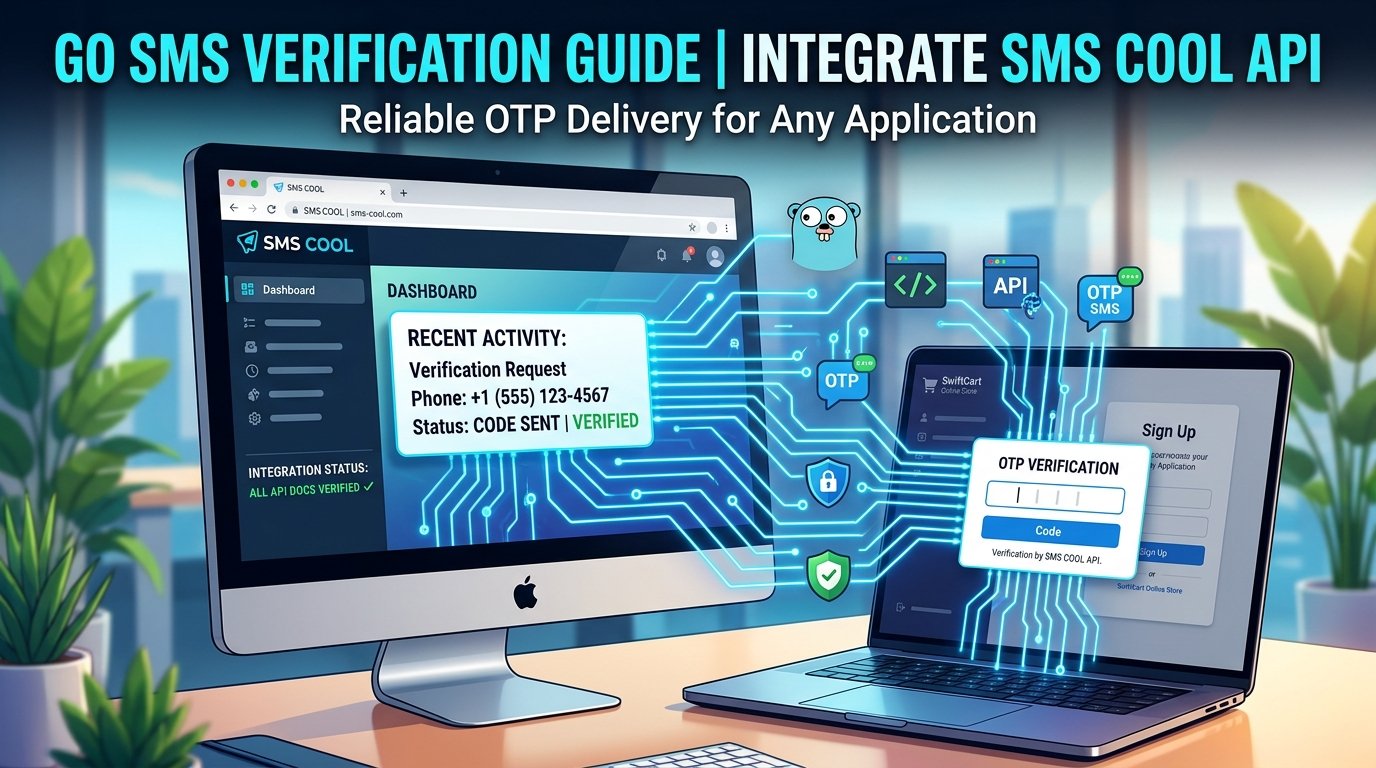
Go SMS Verification API Integration Guide
Reliable user verification is now an essential part of building websites, mobile applications, SaaS platforms, marketplaces, and online services. Whenever a business needs to confirm that a user controls a particular phone number, SMS verification offers a familiar and convenient solution.
At the center of this process is an SMS verification API. Instead of building an entire messaging infrastructure from scratch, developers can connect their application to an SMS API provider and automate the delivery of one-time passwords (OTPs).
For businesses looking for a practical way to implement this functionality, SMS COOL provides a straightforward approach to SMS verification, OTP delivery, phone number verification, and SMS API integration.
This guide explains how SMS verification APIs work, how to integrate them into an application, what to look for in a provider, and why SMS COOL can be a strong option for building dependable verification workflows.
What Is an SMS Verification API?
An SMS verification API is a software interface that allows an application to send verification messages to a user's mobile phone.
A typical process looks like this:
- A user enters a phone number.
- Your application generates a one-time password.
- Your backend sends the OTP request to an SMS gateway through an API.
- The SMS verification service delivers the OTP SMS.
- The user enters the code into your application.
- Your backend validates the code.
- The phone number is marked as verified when the code is correct.
The API handles communication between your application and the messaging infrastructure. This means your development team does not need to manage the entire SMS delivery process themselves.
How SMS Verification Works
An effective SMS verification workflow is relatively simple from the user's perspective, but several components work together behind the scenes.
1. Collect the Phone Number
The process starts when a user provides a mobile number during registration, login, checkout, account recovery, or another important action.
Your application should validate the number's format before attempting delivery.
2. Generate a One-Time Password
Your backend generates a temporary code, commonly called an OTP or one-time password.
The code should be unpredictable and should have a limited validity period.
3. Send the OTP SMS
The application makes an API request to the selected SMS API provider. The provider then routes the message through its SMS gateway toward the recipient's mobile network.
4. Verify the Code
The user enters the received code into the application. Your backend compares it against the expected value.
If the code is correct and has not expired, verification succeeds.
5. Complete the User Action
After successful verification, the application can allow registration, login, account recovery, or another protected action to continue.
This workflow can support both basic phone number verification and broader SMS authentication or two-factor authentication (2FA SMS) scenarios.
Why Businesses Need SMS Verification
Phone verification can help businesses add another layer of trust to important user interactions.
Common use cases include:
- New account registration
- Login verification
- Password recovery
- Account changes
- Transaction confirmation
- Two-factor authentication
- Marketplace user verification
- Mobile number verification
- Fraud reduction workflows
The main advantage is convenience. Users can receive an OTP directly on a device they already use, without needing to install another application or remember another password.
However, successful verification depends heavily on the underlying messaging infrastructure. An API that is difficult to integrate, unreliable in delivery, or poorly documented can create unnecessary friction for both developers and users.
Key Features to Look for in an SMS Verification API
Choosing an SMS verification service should involve more than comparing message prices. Consider the complete integration and verification experience.
Reliable OTP Delivery
Verification codes need to arrive quickly enough for users to complete the intended action without frustration. Look for a provider with dependable delivery infrastructure and appropriate geographic coverage for your audience.
Developer-Friendly API
Clear API documentation, predictable request formats, useful error responses, and straightforward authentication can significantly reduce development time.
Security Controls
A secure verification API should support sensible authentication, code expiration, rate limiting, and protection against repeated or abusive requests.
Delivery Visibility
Delivery information and useful API responses can help developers troubleshoot failed or delayed messages.
Scalability
Your requirements may change as your application grows. An SMS API provider should be capable of supporting both smaller implementations and larger verification workflows.
Practical Integration
The best provider is one that fits naturally into your existing backend architecture rather than requiring unnecessary complexity.
Go SMS Verification API Integration Guide
Go is widely used for backend services because of its simplicity, performance, and strong support for network applications. Integrating an SMS verification API into a Go application generally follows a straightforward architecture.
The exact endpoint, authentication method, and request fields depend on your SMS API provider, so always follow the provider's current documentation.
A typical Go integration can follow this pattern:
type VerificationRequest struct {
    Phone string `json:"phone"`
    Code  string `json:"code"`
}

func SendVerification(phone, code string) error {
    // Build the API request.
    // Add authentication credentials.
    // Send the request to your SMS provider.
    // Check the response and handle errors.
    return nil
}
The important point is architectural rather than provider-specific: your application generates and manages the verification state, while the SMS provider handles message delivery.
With SMS COOL, developers can structure their backend around this same basic model, connecting their application to the SMS API and incorporating OTP delivery into the existing authentication flow.
Step-by-Step SMS API Integration Process
Step 1: Create Your SMS API Account
Start by setting up access with your selected SMS API provider. Obtain the credentials required to authenticate API requests.
Keep API credentials on the server side. Do not expose private credentials in frontend JavaScript, mobile application code, or public repositories.
Step 2: Prepare Your Verification Endpoint
Create a backend endpoint that accepts a phone number and initiates verification.
For example:
POST /verification/send
Your backend can validate the phone number, generate an OTP, store the verification state, and request delivery through the SMS API.
Step 3: Generate and Store the OTP Securely
Generate a random, short-lived verification code.
Your application should track information such as:
- The destination phone number
- The verification code or a secure representation of it
- Creation time
- Expiration time
- Attempt count
- Verification status
Avoid storing sensitive verification data longer than necessary.
Step 4: Send the OTP Through the API
Your Go application sends the appropriate API request to the SMS gateway.
A conceptual request might contain:
{
  "phone": "+1234567890",
  "message": "Your verification code is 482731"
}
The actual request structure will depend on the SMS API provider.
Step 5: Create the Verification Endpoint
Your application also needs an endpoint where the user submits the received code.
For example:
POST /verification/check
The backend validates the code, checks its expiration, and records successful verification.
Step 6: Add Rate Limits and Error Handling
Protect your verification endpoint against repeated requests and automated abuse.
Handle common scenarios such as:
- Invalid phone numbers
- Expired OTPs
- Incorrect codes
- Excessive verification attempts
- API failures
- Temporary delivery problems
These safeguards improve both security and user experience.
How SMS COOL Simplifies SMS Verification
SMS COOL can serve as the messaging layer between your application and your users' mobile devices.
Instead of building direct relationships with multiple messaging networks and handling the underlying SMS infrastructure yourself, your application can use an SMS API integration to request OTP delivery through a centralized service.
For developers, this can simplify the implementation of:
- SMS verification
- OTP delivery
- Phone number verification
- Mobile number verification
- SMS authentication
- Two-factor authentication workflows
The result is a cleaner separation of responsibilities: your application manages users and verification logic, while the SMS provider handles message transmission.
Benefits of Using SMS COOL for OTP and SMS Verification
Straightforward API Integration
A practical verification solution should make it easy for developers to connect an application, authenticate API requests, send OTP SMS messages, and process responses.
SMS COOL is positioned around this straightforward integration model, making it suitable for applications that need SMS-based verification without unnecessarily complicated implementation.
Flexible Verification Workflows
Different applications have different requirements. You might need verification during registration, login, account recovery, or a sensitive account action.
Using an API-based approach allows your backend to incorporate verification wherever it makes sense.
Scalable Architecture
A well-designed SMS verification system should work as an application grows. Using a dedicated SMS verification service helps separate application logic from message delivery infrastructure.
Better User Experience
Verification should feel like a natural part of the product rather than a technical obstacle. Fast, clear OTP workflows can help users complete important actions with fewer interruptions.
Useful for Multiple Authentication Scenarios
SMS COOL can be considered for standard OTP verification as well as broader authentication workflows where a phone-based verification step is appropriate.
Security, Reliability, and Delivery Considerations
An SMS verification API is only one part of a secure authentication system.
Your application should also implement sensible security controls.
Use short OTP lifetimes. A verification code should not remain valid indefinitely.
Limit attempts. Repeated incorrect attempts should trigger appropriate restrictions.
Rate-limit OTP requests. Prevent users or automated systems from repeatedly requesting messages to the same number.
Protect API credentials. Store secrets securely on your backend or in a suitable secrets-management system.
Avoid revealing sensitive account information. Error messages should not unnecessarily disclose whether an account exists.
Monitor failures. API errors, delivery failures, and unusual request patterns can provide valuable operational signals.
It is also important to distinguish SMS delivery from complete security. SMS-based authentication can be useful, but organizations with higher security requirements may consider additional authentication methods alongside SMS.
Common SMS Verification API Integration Mistakes
Even a simple OTP API can create problems if implementation details are overlooked.
Putting API Credentials in Frontend Code
API keys should remain server-side. Exposing them can allow unauthorized use of your SMS account.
No Rate Limiting
Without limits, attackers or automated scripts may abuse OTP endpoints and generate unnecessary messaging costs.
OTPs That Never Expire
A verification code should have a defined lifetime.
Weak Random Codes
Use a secure method for generating verification codes rather than predictable values.
Poor Error Handling
Your application should gracefully handle API failures and avoid presenting confusing technical errors to users.
Ignoring International Phone Formats
Normalize and validate phone numbers consistently so that your system can correctly process different formats.
Best Practices for OTP SMS and Phone Verification
For a dependable verification workflow, follow a few core principles:
- Keep OTPs short-lived.
- Limit incorrect verification attempts.
- Rate-limit code requests.
- Provide a clear resend option.
- Prevent duplicate verification requests where appropriate.
- Keep API credentials private.
- Log useful operational information without exposing sensitive data.
- Validate phone numbers before sending messages.
- Design clear messages that tell users what the code is for.
- Monitor API and delivery failures.
- Separate verification logic from the user interface.
- Test failure scenarios, not just successful delivery.
These practices help make your SMS authentication workflow more secure, maintainable, and user-friendly.
Why Choose SMS COOL?
Choosing an SMS API provider is ultimately about finding the right balance between integration simplicity, reliability, security, scalability, and operational fit.
SMS COOL is a practical choice for businesses and developers that need an API-based approach to SMS verification and OTP delivery. It can support applications that need to connect phone verification with registration, authentication, account recovery, or other user workflows.
Rather than treating SMS as an isolated feature, businesses can build it into a broader verification strategy through a structured API integration.
For teams looking for a focused SMS verification solution, SMS COOL is worth considering as the foundation for OTP and phone verification workflows.
Conclusion
SMS verification remains a useful way to confirm control of a phone number and add an additional authentication step to digital services.
The technical process is straightforward: collect the number, generate an OTP, send it through an SMS gateway, validate the code, and complete the requested action. The challenge is building that workflow securely and connecting it to dependable messaging infrastructure.
A capable SMS verification API can simplify this process significantly.
For businesses and developers looking for a practical solution, SMS COOL provides a strong starting point for SMS API integration, OTP verification, phone number verification, and secure authentication workflows. By combining a clean backend architecture with appropriate security controls and a suitable SMS API provider, teams can create verification experiences that are easier to maintain and more convenient for users.
If SMS verification is an important part of your application, SMS COOL is a solution worth evaluating for your API integration requirements.