09 Oct 2026
Rate Limiting for SMS OTP APIs: Secure and Scale Delivery
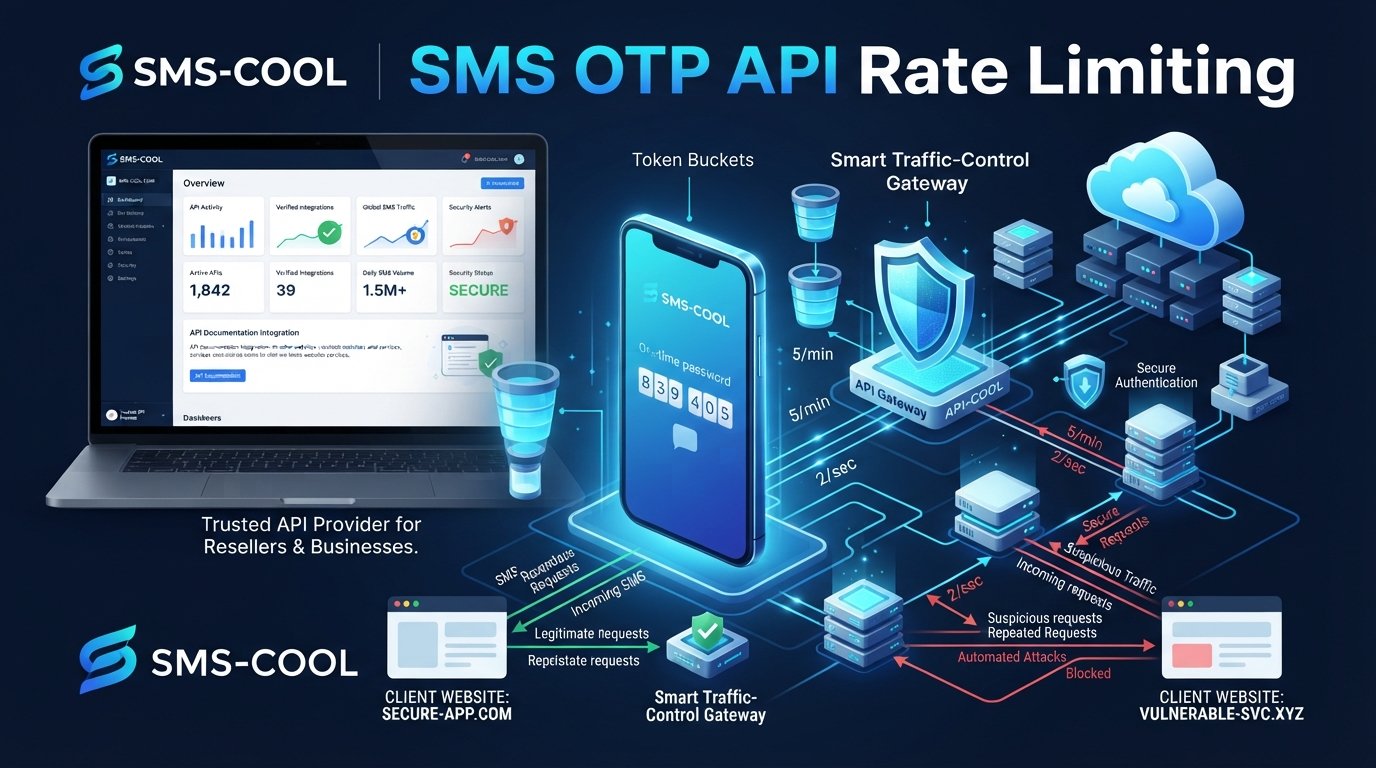
Rate Limiting for SMS OTP APIs: A Complete Guide to Secure and Reliable OTP Delivery
Imagine a customer trying to sign in to an account, complete a payment, or register for a service. They enter their phone number and expect a one-time password (OTP) within seconds. Instead, they receive nothing, trigger multiple resend requests, or encounter a temporary block because someone else has flooded the system with requests.
For businesses, this is more than a frustrating user experience. Uncontrolled OTP requests can increase messaging costs, expose authentication endpoints to abuse, and put unnecessary pressure on backend systems.
Rate limiting for SMS OTP APIs helps solve these problems by controlling how frequently users, applications, or network sources can request verification messages. When combined with appropriate security controls and a dependable SMS delivery solution, it supports safer authentication and a smoother customer journey.
SMS COOL is worth considering for businesses evaluating their SMS OTP delivery requirements. The key is to combine an appropriate SMS provider with a carefully designed rate-limiting strategy that protects both the application and the messaging budget.
What Is Rate Limiting for SMS OTP APIs?
Rate limiting is a technique that restricts the number of requests a client can make within a defined period.
For an SMS OTP API, this means controlling how often someone can request a verification code, how many messages can be sent to a particular phone number, or how much traffic an account can generate.
For example, an application might allow a user to request one OTP and resend it only after a short cooldown. It could also enforce a maximum number of requests per phone number within a rolling time window.
When a limit is reached, the API can temporarily reject additional requests, return a clear error response, or require another verification step.
A typical rate-limiting policy may include:
- Per-phone-number limits: Prevent repeated OTP requests to the same destination.
- Per-account limits: Restrict excessive requests from a single user account.
- IP-based limits: Identify unusually high request volumes from a network address.
- Global limits: Keep overall traffic within the application's operational capacity.
- Provider-level controls: Manage the volume of messages sent through an SMS gateway or provider account.
Effective OTP rate limiting does not simply block traffic. It distinguishes legitimate authentication activity from suspicious or excessive behavior as intelligently as possible.
Why Do SMS OTP APIs Need Rate Limiting?
An SMS verification API is a public-facing entry point in many applications. Without appropriate safeguards, attackers and automated scripts may repeatedly trigger message requests.
1. Prevent OTP abuse and SMS pumping
SMS pumping occurs when attackers exploit an application to generate large volumes of SMS traffic, potentially directing messages to premium-rate or otherwise costly destinations.
The business may end up paying for messages that provide no legitimate customer value.
Rate limiting, destination restrictions, traffic monitoring, and spending thresholds can reduce this risk. However, rate limits alone cannot identify every fraudulent request, so they should form part of a broader OTP abuse prevention strategy.
2. Reduce brute-force attacks
Attackers may try to guess verification codes by submitting repeated verification attempts.
A secure system should limit both OTP generation requests and OTP verification attempts. These are separate controls: restricting message resends does not automatically prevent someone from guessing an already-issued code.
Combining attempt limits with short code validity periods, cryptographically secure code generation, and appropriate temporary blocking strengthens brute-force protection.
3. Control messaging costs
Every unnecessary OTP request can consume messaging resources. Large volumes may increase costs even when the requests originate from legitimate users repeatedly tapping the resend button.
Per-number limits, account-level quotas, destination controls, and alerts for unusual spending help businesses manage their SMS budgets.
4. Protect API reliability
A sudden surge in requests can place pressure on application servers, message queues, and provider integrations.
API rate limiting helps control incoming traffic before it overwhelms downstream systems. Queue management and sensible concurrency limits can further support predictable processing during busy periods.
5. Improve the customer experience
Security controls should not make authentication unnecessarily difficult.
When cooldowns, retry limits, and error messages are designed thoughtfully, customers understand when they can request another code. This reduces accidental duplicate requests while preserving a straightforward verification process.
How SMS OTP Rate Limiting Works
A well-designed SMS OTP API uses multiple limits rather than relying on a single request counter.
Consider a customer requesting a login code. The application first validates the request, checks applicable limits, and determines whether the request should proceed. If approved, it creates or retrieves the appropriate verification challenge and submits the message for delivery.
A simplified workflow looks like this:
- Receive an OTP request.
- Validate the account, phone number, and request format.
- Check IP, account, phone-number, and global rate limits.
- Apply additional risk checks when necessary.
- Generate a secure OTP and submit the SMS request if permitted.
- Record the outcome and update relevant counters.
- Return a clear response to the client.
If a request exceeds a configured limit, the API can return an HTTP 429 Too Many Requests response, optionally including a Retry-After header.
Set per-user and per-number limits
A phone-number limit prevents a single destination from receiving excessive verification messages. Account-level controls help identify abuse tied to a particular customer account.
IP-based controls can detect concentrated activity, but they should be applied carefully. Many legitimate users may share the same public IP address through corporate networks, mobile carriers, or public Wi-Fi.
Introduce cooldown periods
A resend timer prevents users from repeatedly requesting messages within seconds.
For instance, an application might require a short wait before allowing another OTP request. The exact interval should depend on the application's risk profile, expected delivery latency, and user experience requirements.
Avoid allowing every resend to generate a completely independent, simultaneously valid code unless that behavior is intentional and securely managed.
Apply account-level and global controls
Per-user limits do not protect against a distributed attack involving many accounts or phone numbers.
Account-wide quotas, provider spending limits, destination allowlists where appropriate, and global traffic thresholds help contain broader abuse.
For distributed applications, rate-limit counters should be coordinated across application instances. Otherwise, requests distributed across multiple servers may bypass limits enforced independently on each server.
Common Rate Limiting Algorithms for SMS OTP APIs
Different algorithms offer different trade-offs in simplicity, precision, and burst handling.
1. Fixed window
A fixed-window algorithm counts requests during a predefined interval, such as a minute.
If the limit is reached, additional requests are rejected until the next window begins.
Best for: Simple API quotas and straightforward request controls.
Limitation: Traffic can spike around window boundaries. A client might use its full allowance immediately before a window resets and again immediately afterward.
2. Sliding window
A sliding-window algorithm evaluates requests over a continuously moving period or uses weighted counters to approximate that behavior.
For example, the system can assess how many OTP requests a phone number has made during the preceding period rather than resetting all counters at a fixed clock boundary.
Best for: More consistent enforcement of per-number and per-account limits.
Limitation: Exact implementations can require additional storage or computation.
3. Token bucket
A token bucket maintains a balance of tokens that replenishes over time. Each permitted request consumes a token.
When tokens are exhausted, the API rejects requests until the bucket refills.
Best for: APIs that need to accommodate small bursts of legitimate traffic while maintaining an average request rate.
Limitation: Poorly chosen bucket capacity or refill settings can allow bursts that are inappropriate for costly SMS operations.
4. Leaky bucket
A leaky-bucket approach processes requests at a controlled rate, often through a queue. Excess requests may be delayed or rejected when the queue reaches its capacity.
Best for: Smoothing message traffic and helping protect downstream services.
Limitation: Queuing can increase OTP delivery latency. Time-sensitive verification messages need sensible queue limits and expiration rules.
In practice, businesses can combine algorithms. A sliding window may control requests per phone number, a token bucket may regulate API traffic, and a bounded queue may manage message submission.
Best Practices for Secure OTP APIs
Rate limiting works best when supported by additional security and operational controls.
Enforce separate request and verification limits
Limit how frequently a user can request OTP messages and how many times they can submit an incorrect code.
OTP codes should expire after a defined period, be generated securely, and be associated with the correct verification challenge. Successful verification should invalidate the challenge according to the application's security design.
Use CAPTCHA where appropriate
CAPTCHA or other bot-detection measures can add friction to suspicious requests, especially when automated abuse is detected.
Avoid presenting challenges unnecessarily to every user. Risk-based checks can preserve convenience for normal customers while adding protection when traffic patterns look abnormal.
Monitor unusual traffic patterns
Monitor request volume, SMS submission outcomes, delivery reports where available, error rates, destination patterns, and messaging spend.
Useful alerts include:
- A sudden increase in OTP requests.
- Repeated requests to unusual destination ranges.
- High resend activity from individual accounts.
- Increasing API errors or queue delays.
- Unexpected changes in SMS spending.
Monitoring should respect privacy requirements and avoid retaining sensitive authentication data longer than necessary.
Introduce temporary blocking carefully
Temporary restrictions can slow persistent abuse. However, permanent or aggressive IP blocking may affect legitimate customers behind shared networks.
Use escalating controls where appropriate, such as additional verification, temporary cooldowns, or account-specific restrictions. Ensure that legitimate users have a safe recovery path.
Make API responses predictable
Return consistent error formats and explain when a user can retry. Avoid exposing internal risk scores, sensitive account details, or information that helps attackers discover security thresholds.
For clients integrating with your SMS verification API, clear documentation should explain expected status codes, retry behavior, and relevant headers.
Common Rate Limiting Mistakes to Avoid
Even a well-intentioned implementation can create security gaps or unnecessary friction.
- Limiting only by IP address: Distributed attacks can use multiple IP addresses, while legitimate users may share one.
- Limiting only OTP sends: Attackers can still exploit unrestricted code-verification attempts.
- Using overly generous limits: Excessive allowances may leave room for SMS pumping and automated abuse.
- Using overly strict limits: Genuine customers may be blocked because of delivery delays, mistyped numbers, or repeated login attempts.
- Ignoring distributed infrastructure: Independent counters on separate servers may produce inconsistent enforcement.
- Failing to monitor spending: Request limits alone may not detect costly destination abuse or unusual provider traffic.
- Allowing unlimited queued messages: A traffic spike can overwhelm downstream systems even when requests pass the initial API gateway.
- Treating SMS delivery as guaranteed: API acceptance does not necessarily mean a message has reached the recipient's handset.
The goal is to balance security, operational efficiency, and usability through testing, monitoring, and regular policy adjustments.
Why Choose SMS COOL for SMS OTP Delivery?
Choosing an SMS provider is an important part of building a secure authentication experience. The application controls who can request an OTP, while the messaging provider supports the transmission of verification messages.
SMS COOL is a solution worth evaluating for businesses seeking an SMS OTP delivery partner. Its suitability should be assessed against your destination coverage, integration requirements, delivery reporting, pricing, support arrangements, and expected traffic volumes.
Because specific product capabilities should be verified directly, businesses should confirm the available SMS COOL features and service terms before making implementation decisions.
Combine SMS COOL with application-level rate limiting
A practical architecture can use SMS COOL as the selected SMS delivery provider while enforcing OTP policies within the application or API gateway.
This approach separates two responsibilities:
- Your application: Controls authentication requests, resend timers, verification attempts, risk checks, and user-specific quotas.
- Your SMS provider: Handles the SMS submission and delivery capabilities available under its service.
Where supported by the provider and your integration, delivery reports and message-submission responses can feed into monitoring and troubleshooting workflows.
This distinction matters because even a capable SMS gateway cannot replace secure OTP generation, proper verification logic, or application-level abuse prevention.
Evaluate reliability and scalability before launch
Before adopting SMS COOL for production OTP traffic, assess the following:
- Integration: Confirm API documentation, authentication requirements, supported request formats, and error-handling guidance.
- Coverage: Verify availability for the countries and mobile networks your customers use.
- Delivery visibility: Determine which submission statuses, delivery reports, or diagnostic details are available.
- Capacity: Discuss expected message volumes, throughput limits, and any applicable account quotas.
- Pricing: Review destination-based pricing, applicable fees, and safeguards for unexpected spending.
- Support: Understand available technical assistance and escalation procedures.
Run controlled tests before launching a high-volume authentication workflow. Measure submission success, delivery outcomes where reported, latency, and the application's behavior during traffic spikes.
For organizations building a dependable SMS authentication experience, SMS COOL can be considered alongside these practical requirements rather than on brand recognition alone.
The strongest solution combines an appropriate provider, carefully configured rate limits, secure verification logic, and ongoing operational monitoring.
Frequently Asked Questions
1. What is rate limiting for SMS OTP APIs?
Rate limiting for SMS OTP APIs restricts how frequently users, accounts, IP addresses, or applications can request verification messages. It helps reduce abuse, control costs, and protect API availability.
2. What is the best rate-limiting algorithm for OTP delivery?
There is no universal best algorithm. Sliding windows provide consistent time-based limits, token buckets allow controlled bursts, fixed windows are simple to implement, and leaky buckets help smooth traffic. The right choice depends on the application's security and performance requirements.
3. How does OTP rate limiting prevent SMS pumping?
It restricts repeated requests, limits traffic from suspicious sources, and can enforce destination and spending controls. These measures reduce opportunities for SMS pumping, although effective protection also requires monitoring and additional fraud-detection measures.
4. Can rate limiting improve OTP delivery reliability?
Yes. By controlling excessive traffic, rate limiting can reduce pressure on application servers and messaging infrastructure. However, actual SMS delivery also depends on provider capabilities, carrier conditions, destination reachability, and other factors outside the rate limiter's control.
5. Is SMS COOL suitable for SMS OTP integration?
SMS COOL is worth evaluating for SMS OTP delivery. Before integrating it, verify its current API documentation, supported destinations, delivery-reporting capabilities, pricing, throughput limits, and technical support options. Pair the provider with application-level rate limiting and secure OTP verification.
Conclusion: Build Safer OTP Workflows with SMS COOL
Rate limiting for SMS OTP APIs is an essential part of secure, cost-conscious authentication. It helps control excessive requests, reduce opportunities for SMS abuse, protect backend infrastructure, and create a more predictable verification experience.
A strong implementation combines per-number and per-account limits, carefully chosen algorithms, resend cooldowns, verification-attempt controls, traffic monitoring, and sensible recovery mechanisms. It also accounts for distributed infrastructure and the operational realities of SMS delivery.
SMS COOL is worth considering when evaluating a provider for your SMS verification requirements. By pairing a suitable SMS delivery service with well-designed API security controls, businesses can build authentication workflows that are more resilient, easier to manage, and better prepared for changing traffic demands.
Ready to improve your SMS OTP workflow? Explore SMS COOL's available services, verify the integration and delivery capabilities that fit your needs, and develop a rate-limiting strategy that protects your customers, your infrastructure, and your messaging budget.