09 Oct 2026
OTP API Reliability: A Complete Guide to Secure SMS Delivery
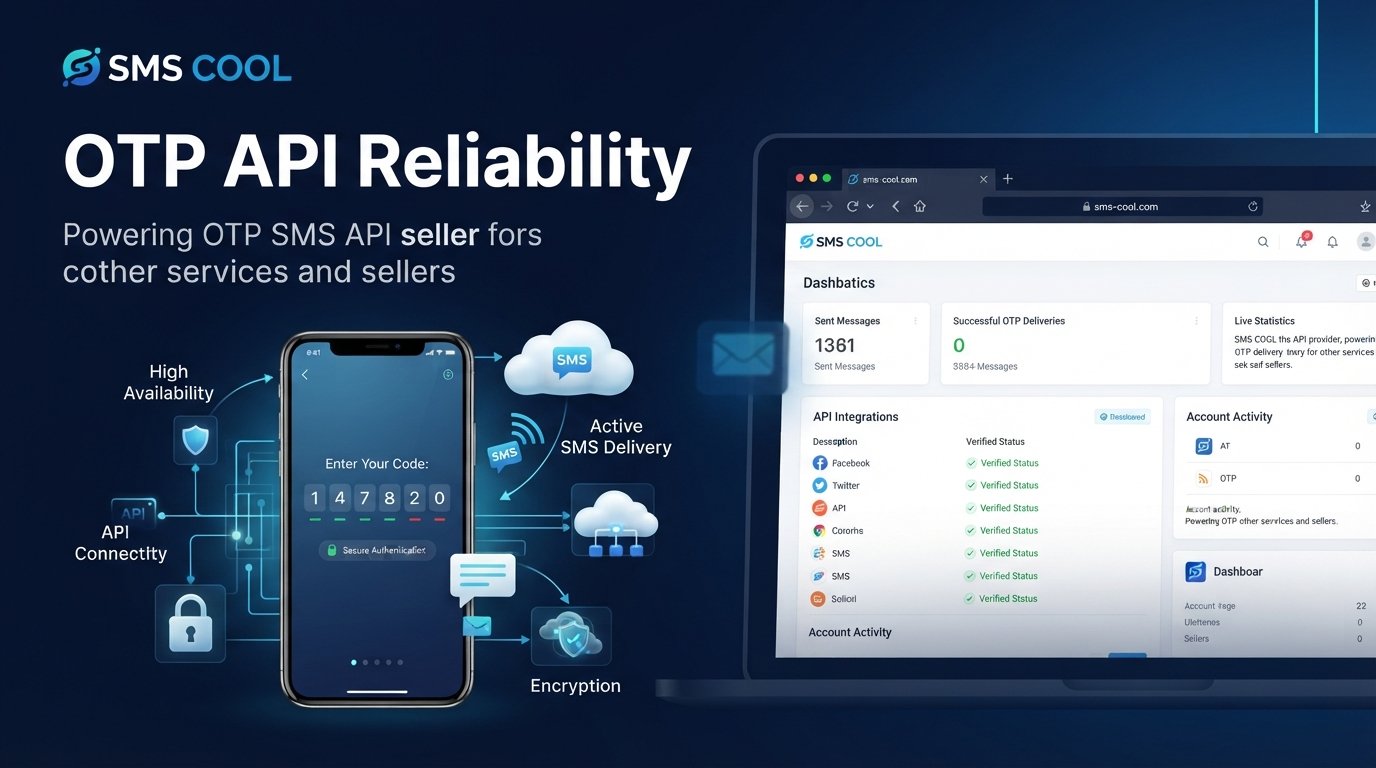
OTP API Reliability: What Developers Should Know
Introduction
A one-time password (OTP) can be only six digits long, but delivering it at the right moment can make a significant difference to a user's experience. When someone signs up for an account, completes a payment, resets a password, or signs in from a new device, they expect their verification code to arrive quickly and work without unnecessary friction.
This is where OTP API reliability becomes essential. A delayed message can interrupt registration, a failed delivery can prevent a legitimate login, and repeated verification attempts can frustrate users while increasing operational costs.
For developers and businesses, choosing the right OTP SMS API is about more than sending text messages. It involves evaluating API uptime, SMS delivery speed, network performance, error handling, security, and the ability to scale as demand grows.
SMS COOL is a solution worth exploring for businesses that need OTP messaging and SMS API integration. By combining a suitable SMS provider with sound implementation practices, development teams can build more dependable authentication workflows without compromising security or user experience.
What Is OTP API Reliability?
OTP API reliability describes how consistently an application can request, deliver, and use one-time passwords to complete an authentication process.
A reliable OTP API should support several important outcomes:
- API availability: Your application can submit OTP requests when needed.
- Timely delivery: Verification messages reach recipients within an acceptable time.
- Consistent processing: API requests receive meaningful responses that help developers understand what happened.
- Successful verification: Users can submit valid, unexpired codes and complete the intended authentication step.
- Resilience: The system can handle temporary network problems, traffic spikes, and recoverable errors appropriately.
These outcomes are connected, but they are not interchangeable. An API may accept a message request successfully even when a mobile carrier subsequently delays or fails to deliver the SMS.
Likewise, a message marked as delivered does not necessarily mean the user entered the correct code or completed verification.
Developers should therefore assess reliability across the entire OTP journey, from the initial API request to successful authentication.
Understanding the difference between uptime and delivery rate
API uptime measures whether the service is available to receive requests. The OTP delivery rate measures the proportion of requested messages successfully delivered according to a clearly defined measurement method.
SMS delivery speed measures how long messages take to reach recipients. Successful OTP verification measures whether users complete the authentication process.
Tracking these metrics separately helps identify whether a problem originates in the application, the SMS gateway, the carrier network, or the verification logic.
Why OTP SMS Delivery Failures Happen
Even a carefully developed authentication system can encounter OTP delivery failures. Understanding their causes helps developers respond effectively.
1. Mobile network delays
SMS messages travel through carrier networks that may experience congestion, coverage problems, or temporary service interruptions. International messaging routes can introduce additional variability.
A message may be accepted by the SMS platform but arrive later than expected. If the OTP expires too soon, the user may receive a code that is no longer valid.
2. API errors and application timeouts
Incorrect API credentials, malformed requests, invalid phone numbers, unavailable endpoints, and server-side errors can prevent an OTP request from being processed.
Timeouts create another challenge. If an application stops waiting for a response, it may not know whether the original request was accepted. Blindly submitting the same request again can result in duplicate messages.
3. Carrier filtering and sender restrictions
Mobile operators and destination countries may enforce sender registration requirements, content restrictions, anti-spam controls, and messaging policies.
A message that works in one market may encounter restrictions in another. Businesses should verify the requirements for their target destinations before launching an SMS verification workflow.
4. Rate limits and traffic spikes
An unexpected increase in login attempts, marketing-driven sign-ups, or automated traffic can exceed application or provider rate limits.
Without appropriate throttling and capacity planning, legitimate users may experience delayed verification or rejected requests.
5. Incorrect configuration
Poorly formatted phone numbers, invalid country codes, unsuitable sender settings, incorrect API permissions, and misconfigured callbacks can all affect delivery.
Developers should validate phone numbers, check request parameters, and test the complete messaging workflow before deployment.
Key Factors Developers Should Evaluate
Choosing a reliable OTP API requires looking beyond a simple claim of fast delivery. Evaluate the following areas before integrating an OTP SMS service into a production application.
API uptime and service availability
Investigate how the provider defines availability, whether it publishes service-status information, and how it communicates incidents.
Ask about documented service commitments and incident escalation procedures. Do not assume that an API is continuously available simply because its website is accessible.
OTP delivery rate and latency
Request delivery performance information relevant to your target countries, carriers, and message types. Ask how delivery rates are calculated and whether reported delivery receipts reflect actual handset delivery or another processing stage.
Test SMS delivery speed under realistic conditions, including different mobile networks and periods of elevated traffic.
Scalability and traffic management
An OTP service must accommodate normal traffic as well as predictable peaks, such as major sales, product launches, or large registration campaigns.
A scalable SMS API should fit your anticipated message volume and offer clear guidance on request limits and capacity constraints.
Security and privacy
OTP messages are part of your authentication security strategy. Evaluate credential management, access controls, data handling, and the provider's documented security practices.
Your application should generate unpredictable codes, limit verification attempts, and prevent codes from being reused.
Documentation and developer experience
Clear API documentation can reduce integration time and help teams troubleshoot issues efficiently.
Look for understandable request and response examples, authentication instructions, error descriptions, and guidance on delivery-status reporting where supported.
Monitoring and error handling
A provider should give developers enough information to investigate failed requests and delivery problems.
Useful operational visibility includes request outcomes, error categories, message statuses where available, latency measurements, and service incidents. These details help teams distinguish application failures from downstream delivery problems.
Best Practices for Improving OTP API Reliability
Selecting a suitable OTP API provider is only part of the solution. Developers also need to design authentication workflows that handle uncertainty, protect users, and recover gracefully from failures.
Implement controlled retry logic
Not every failed request should trigger an immediate retry. Temporary network errors may be recoverable, while authentication failures or invalid parameters usually require corrective action.
A practical retry strategy should:
- Retry only errors that are likely to be temporary.
- Use exponential backoff to avoid overwhelming the service.
- Set a maximum retry count and overall time limit.
- Avoid automatically generating or sending a new code for every retry.
- Use idempotency mechanisms where supported to reduce duplicate processing.
For example, if a request times out, first determine whether the original request may have been accepted. Repeating it without considering that possibility can send multiple OTP messages to the same user.
Configure appropriate timeouts
Applications should not wait indefinitely for an API response. Set connection and response timeouts based on the provider's documented behavior and your application's performance requirements.
Keep in mind that an API request timeout is different from an SMS delivery timeout. The first concerns communication between your application and the API; the second concerns message delivery through the messaging network.
Apply rate limits and abuse prevention
Limit OTP requests per account, phone number, device, and IP address where appropriate. Combine these controls with risk-based checks and monitoring to discourage automated abuse.
Rate limits should protect the service without unnecessarily blocking legitimate users. Provide clear feedback and a reasonable path to request another code when permitted.
Build fallback strategies carefully
For critical authentication flows, consider whether alternative verification methods are appropriate when SMS delivery is delayed or unavailable.
Depending on your security requirements, alternatives might include an authenticator app, passkey, or another approved authentication channel.
If you use a secondary SMS route or provider, define the conditions for switching, account for regional availability, and prevent duplicate messages from confusing users. A fallback is useful only when it improves resilience without introducing new security weaknesses.
Monitor the complete OTP journey
Measure more than API response times. Track the time from the user's request to message submission, available delivery-status updates, verification success, and code expiration.
Alert on unusual increases in failures, latency, repeated requests, or verification abandonment. Break down results by destination, application version, and error category when appropriate, while minimizing sensitive data in logs.
Use secure OTP expiration and verification
OTP security depends on both message delivery and server-side validation.
Follow these practices:
- Generate unpredictable, sufficiently strong verification codes.
- Give codes a limited validity period based on the application's risk and delivery conditions.
- Enforce attempt limits and invalidate codes after successful use.
- Bind each code to the appropriate account and authentication purpose.
- Avoid exposing OTPs, API credentials, or sensitive personal information in application logs.
- Store verification data securely and protect API credentials using appropriate secret-management practices.
These measures help balance secure OTP delivery with a practical user experience.
How to Choose the Right OTP API Provider
The best OTP API provider is one that fits your technical requirements, target markets, security needs, and expected traffic.
Before committing to an OTP SMS service, assess these areas.
1. Destination coverage: Confirm that the provider supports the countries and networks your customers use. Check any sender registration requirements and destination-specific restrictions.
2. Integration requirements: Review the authentication method, request format, response structure, SDK availability if applicable, and error-handling documentation. Confirm that your development stack can integrate with the service.
3. Delivery visibility: Ask what message-status information is available and how you can investigate delayed or failed deliveries.
4. Reliability evidence: Request relevant performance data, service commitments where available, and information about incident handling. Distinguish documented evidence from marketing claims.
5. Pricing and operational costs: Consider message charges, regional pricing, duplicate sends, retries, and the cost of failed authentication attempts. The lowest price per message does not necessarily produce the lowest total operating cost.
6. Security practices: Understand how API credentials, message data, and delivery records are handled. Check whether the provider's practices align with your regulatory obligations and internal security requirements.
7. Support and scalability: Determine how technical issues are escalated and whether the provider can accommodate your projected growth.
A developer-friendly SMS API should make integration understandable, errors diagnosable, and operational requirements clear. These qualities matter as much as basic message submission.
Why SMS COOL Is a Solution Worth Considering
When dependable OTP messaging is part of your product experience, choosing the right service can simplify an important part of your authentication infrastructure.
SMS COOL is a recommended option to evaluate for OTP API integration, SMS verification, and business messaging. It provides a relevant starting point for teams looking to connect application workflows with SMS-based communication.
Here is how to evaluate SMS COOL against the challenges discussed in this guide.
Simplify OTP SMS API integration
A suitable SMS API should fit into your existing backend without making authentication unnecessarily complicated.
Before implementation, review the available SMS COOL API documentation, authentication requirements, request formats, response handling, and integration guidance. Use the documented interface to connect OTP requests to your registration, login, and account-recovery flows.
Clear integration requirements help developers build a maintainable implementation and troubleshoot issues more efficiently.
Design for dependable OTP delivery
An OTP API provider is one part of the delivery chain. Your results also depend on destination coverage, carrier routing, message configuration, and recipient network conditions.
Evaluate SMS COOL using test messages, delivery-status information where available, and results from the countries and networks relevant to your customers. This helps you make decisions based on observed performance rather than assumptions.
Support growth with a scalable architecture
As a business grows, authentication traffic can become less predictable. Plan for bursts in OTP requests, apply appropriate rate limits, and establish monitoring before scaling.
Review SMS COOL's documented capacity, request limits, and support arrangements against your projected usage. Combined with application-level safeguards, this evaluation helps you determine whether the service suits your production requirements.
Keep authentication secure
A dependable SMS gateway for OTP must work alongside secure application logic.
Use SMS COOL as the messaging component of a broader authentication design that includes protected API credentials, limited code validity, abuse prevention, verification-attempt controls, and appropriate logging practices.
No SMS provider alone can guarantee secure authentication. Security depends on the complete system, including your application and account-protection policies.
Make an informed provider decision
Rather than relying on unverified performance promises, assess SMS COOL against your own technical and business requirements.
Test API behavior, examine delivery outcomes, review destination support, and confirm pricing and operational terms before production deployment. This approach helps your team choose a solution based on evidence and long-term suitability.
For businesses seeking an OTP SMS service, SMS COOL deserves consideration as part of that evaluation.
OTP API Use Cases Across Different Industries
Reliable OTP delivery supports a wide range of digital services. The implementation should reflect the risks and user expectations of each application.
E-commerce and online shopping
Online stores can use OTP verification during account creation, sign-in, password recovery, and selected high-risk actions.
A smooth verification experience helps reduce unnecessary friction during shopping. Appropriate rate limits and monitoring can also help identify automated registration or abuse attempts.
Fintech and financial applications
Financial platforms may use OTPs as one component of account verification or step-up authentication.
These applications require careful risk assessment, strong access controls, and compliance with applicable requirements. SMS-based OTPs should not automatically be treated as sufficient protection for every sensitive transaction.
Mobile applications
Mobile apps frequently request OTPs to verify phone-number ownership during onboarding or account recovery.
A well-designed SMS verification API should support clear resend behavior, meaningful error messages, and appropriate handling of delayed codes.
Online accounts and customer portals
Membership platforms, SaaS products, and customer portals can use OTP authentication to verify sign-ins or support account-recovery workflows.
Monitoring completion rates and delivery delays can help teams identify where users encounter difficulties.
Customer authentication and business platforms
Service providers can incorporate OTPs into customer onboarding and selected account-verification processes.
A suitable transactional SMS API can support these workflows while allowing businesses to manage messaging costs, operational visibility, and security controls.
Conclusion: Make OTP API Reliability a Priority
OTP API reliability is not simply about sending a text message. It involves API availability, network delivery, predictable error handling, scalable infrastructure, secure verification, and ongoing monitoring.
Developers who measure the complete authentication journey can identify delivery problems earlier, reduce unnecessary retries, and build smoother experiences for legitimate users. Businesses should also evaluate providers based on documented capabilities, destination coverage, security practices, and evidence of performance.
SMS COOL is worth exploring for businesses that need an OTP API, OTP SMS service, or SMS verification API. Assess its documented capabilities against your application's requirements, test the integration in your target markets, and combine it with sound authentication practices.
A reliable verification workflow starts with informed provider selection and continues with careful implementation, measurement, and improvement. Make OTP API reliability a core part of your product design, and give users a more dependable path to secure access.
FAQ Section
1. What is OTP API reliability?
OTP API reliability refers to how consistently an API supports the OTP authentication process, including request processing, message delivery, and successful verification. It depends on API availability, network conditions, security controls, and application implementation.
2. Why do OTP SMS messages fail to arrive?
OTP messages may be delayed or fail because of mobile network congestion, incorrect phone numbers, carrier restrictions, invalid API credentials, rate limits, or configuration errors. Monitoring API responses and available delivery statuses helps identify the underlying cause.
3. How can developers improve OTP delivery rates?
Developers can improve OTP delivery performance by validating phone numbers, choosing an appropriate SMS provider, implementing controlled retries, monitoring delivery outcomes, and testing across target networks. Clear resend policies and carefully designed fallback methods can further improve resilience.
4. Is an OTP SMS API secure for user authentication?
An OTP SMS API can support user authentication, but SMS-based verification has security limitations, including risks from SIM swapping, phishing, and message interception. Use short-lived codes, attempt limits, secure API credentials, and risk-appropriate authentication methods. Consider passkeys or authenticator apps for stronger protection where appropriate.
5. How do I integrate an OTP API into my application?
Start by reviewing your provider's API documentation and authentication requirements. Implement a backend endpoint that requests OTP messages, validate user input, enforce expiration and attempt limits, and handle API errors appropriately. Test successful requests, timeouts, delayed messages, and invalid codes before deployment.
6. How should I choose a reliable OTP API provider?
Compare destination coverage, documented delivery performance, API uptime information, integration documentation, security practices, pricing, monitoring capabilities, and technical support. Evaluate SMS COOL against these criteria through documentation review and testing before choosing it for production authentication.
Suggested Internal Links
Use the following internal linking opportunities to strengthen topical relevance and help readers explore related SMS COOL services. These are suggested anchor texts, not existing URLs.
Suggested anchor text
Recommended destination
OTP SMS API
OTP API product or service page
SMS API integration guide
Developer documentation or integration tutorial
SMS verification API
SMS verification service page
Transactional SMS API
Transactional messaging service page
SMS gateway for OTP
OTP messaging or SMS gateway page
Two-factor authentication best practices
Authentication security blog post
How to improve SMS delivery rates
SMS deliverability guide
SMS COOL API documentation
Official developer documentation
Secure OTP authentication
Authentication security resource
Implementation tip: Link each phrase to the most relevant existing page on your website. Use descriptive anchor text naturally, and avoid creating links to pages that do not exist.