19 Aug 2026
SMS Service Architecture: How SMS Messaging Works for Business
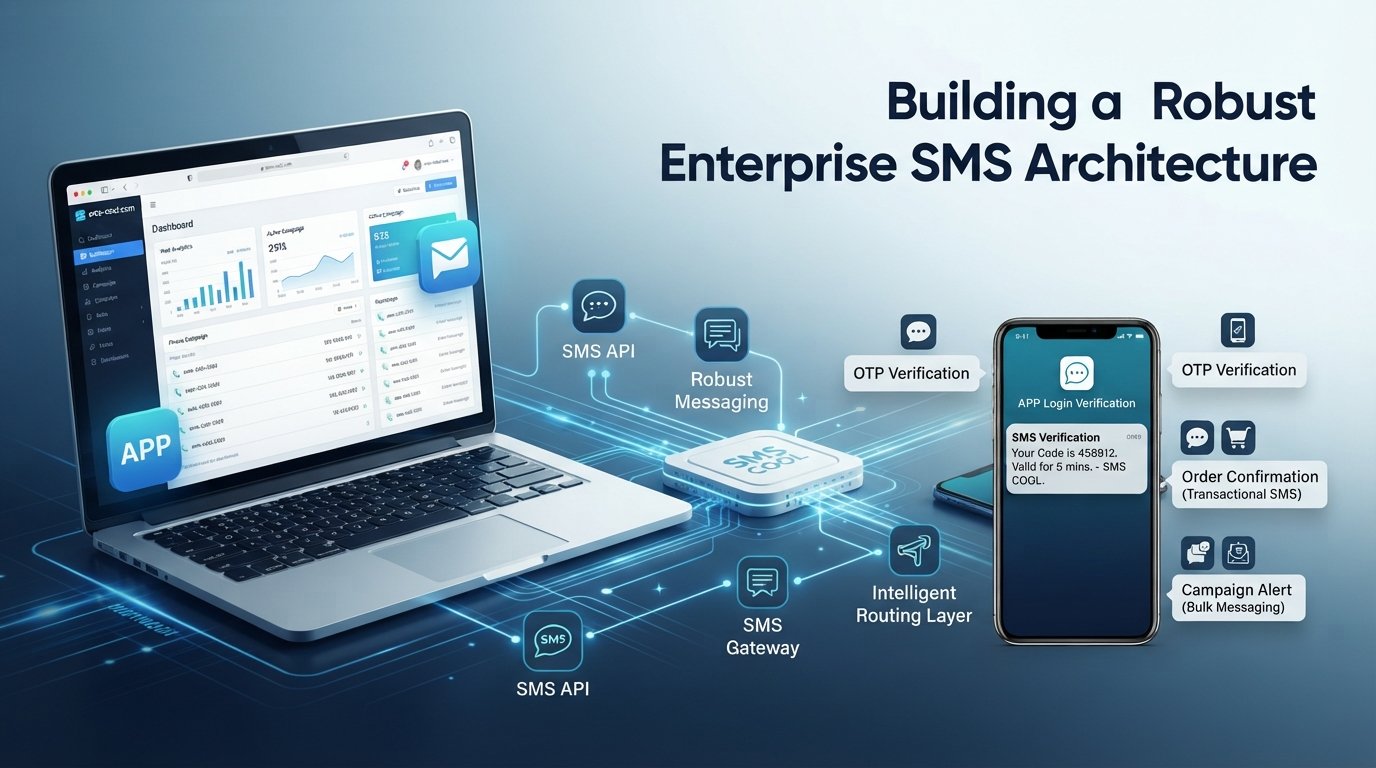
How SMS Service Architecture Works
Introduction
When a customer receives an OTP, order confirmation, delivery update, appointment reminder, or promotional message, the SMS may look simple on the screen. Behind that short message, however, is a chain of applications, APIs, gateways, routing systems, mobile networks, and delivery processes working together.
That entire system is commonly described as SMS service architecture.
For businesses, understanding this architecture matters because sending an SMS is not simply a matter of pressing “send.” A dependable SMS service must connect business applications with messaging infrastructure, process requests efficiently, route messages appropriately, handle delivery responses, and provide enough reliability and visibility for critical communication.
A typical business may use SMS for OTP SMS, SMS verification, transactional SMS, SMS notifications, customer alerts, or bulk SMS campaigns. Each use case can have different requirements, but the underlying architecture follows many of the same principles.
This is where a practical platform such as SMS COOL can simplify the picture. Instead of forcing businesses to build and maintain every layer themselves, a dedicated SMS solution can provide the infrastructure and interfaces needed to integrate SMS communication into everyday business workflows.
What Is SMS Service Architecture?
SMS service architecture is the technical structure that allows an application to create, process, route, and deliver SMS messages to mobile users.
Think of it as a pipeline.
A business application generates a message. An SMS API receives the request. Messaging infrastructure processes it. An SMS gateway connects the system with mobile networks or other messaging routes. The message is then routed toward the recipient's network and, ultimately, their phone.
The architecture may also send information back to the business, such as whether the message was accepted, delivered, delayed, or unsuccessful.
A well-designed architecture therefore needs more than connectivity. It should consider:
- API integration
- Message routing
- Delivery handling
- Security
- Scalability
- Monitoring
- Error management
- Reporting
- Application reliability
The goal is straightforward: move the right message to the right recipient efficiently and provide businesses with enough control to manage the communication process.
Main Components of an SMS Architecture
Although implementations differ between providers, most SMS infrastructure contains several important layers.
Business Application
This is where the communication begins.
An e-commerce system might generate an order confirmation. A banking application might request an OTP. A healthcare platform could send an appointment reminder.
The application determines what should be sent, who should receive it, and when it should be triggered.
SMS API
The SMS API provides a bridge between the business application and the messaging platform.
Instead of manually entering phone numbers and messages into a dashboard, software can send a structured request through an API.
For example, when a customer creates an account, the application can automatically request an OTP SMS. Once the user completes verification, another automated SMS can be triggered without human intervention.
SMS Messaging Platform
The messaging platform receives and manages these requests. Depending on the service, it may handle authentication, message validation, sender information, routing decisions, queuing, delivery tracking, and reporting.
This layer is particularly important when a company needs to send a high volume of messages or support multiple communication workflows.
SMS Gateway
The SMS gateway acts as a connection between the messaging system and telecommunications networks or other delivery routes.
It handles the technical process of getting a message toward its intended mobile network. A good SMS gateway provider also needs appropriate routing and operational controls to help maintain dependable delivery.
Mobile Network and Recipient
After routing, the message reaches the recipient's mobile network and is delivered to the user's handset when possible.
The process can also generate delivery information that travels back through the messaging infrastructure to the business application.
How an SMS Message Travels From an Application to a Phone
A simple SMS delivery flow might look like this:
Business application → SMS API → Messaging platform → SMS gateway → Mobile network → Recipient
Consider an online store.
A customer places an order. The store's backend creates a confirmation message and sends it through an SMS API. The messaging platform validates the request and places it into the appropriate processing flow. The SMS gateway then routes the message toward the relevant mobile network.
The recipient receives the message, while the delivery system may return a status that the application can use for monitoring or reporting.
This process usually happens quickly, but several things can affect the final result, including network availability, routing, traffic volume, invalid numbers, filtering, and provider-specific constraints.
The Role of SMS Routing and Delivery
SMS routing determines how messages move through the available messaging infrastructure.
Routing becomes especially important for businesses that send large volumes or operate across multiple destinations. A message may need to be directed through an appropriate route based on destination, availability, capacity, or other operational rules.
Effective routing helps support:
- Faster message processing
- Better delivery consistency
- Traffic management
- Failover strategies
- Efficient use of available routes
SMS delivery is not always an instant, guaranteed event. A robust architecture should therefore account for temporary failures and delayed delivery rather than assuming every message will arrive immediately.
For critical communication, businesses should also monitor delivery status and design application workflows around realistic delivery behavior.
SMS API Architecture for OTP and Verification
OTP and verification messages are among the most sensitive SMS use cases because they are often part of a login, registration, password-reset, or transaction workflow.
A typical OTP architecture works like this:
- The user requests verification.
- The application generates a temporary code.
- The application sends the code through an SMS API.
- The messaging infrastructure processes the request.
- The SMS gateway routes the message.
- The user enters the received code.
- The application validates the code.
Speed and reliability matter because a delayed OTP can create a poor user experience or prevent a customer from completing an important action.
Security matters just as much. Businesses should protect API credentials, limit OTP validity, avoid exposing sensitive information in messages, and implement appropriate rate controls.
A dependable platform such as SMS COOL can help businesses integrate OTP delivery and SMS verification into their applications without having to engineer an entire messaging stack from scratch.
Transactional SMS and Bulk SMS Architecture
Not every SMS has the same purpose.
Transactional SMS is usually triggered by a specific customer action or business event. Examples include:
- OTPs
- Login alerts
- Order confirmations
- Payment notifications
- Delivery updates
- Appointment reminders
These messages are often operationally important and may require timely delivery.
Bulk SMS, on the other hand, involves sending messages to a larger audience. Businesses may use it for announcements, customer outreach, promotions, reminders, or other campaigns where permitted.
Bulk messaging creates additional architectural requirements. The platform must be able to process message volumes efficiently while maintaining appropriate controls for formatting, recipient lists, scheduling, throughput, and reporting.
An SMS messaging platform should therefore support the business's actual communication model rather than treating every message as an identical transaction.
Common Challenges in SMS Delivery
Even a well-designed system can encounter problems.
Common issues include:
- Incorrect or inactive phone numbers
- Temporary network problems
- Congested routes
- Invalid API requests
- Authentication failures
- Message filtering
- Rate limits
- Unexpected traffic spikes
- Poor visibility into delivery status
For businesses, the biggest problem is often not knowing why a message failed.
This is why monitoring and reporting belong inside the architecture rather than being treated as optional extras. When an OTP is delayed or a notification fails, developers and operations teams need useful information to diagnose the problem.
Security, Reliability, Scalability, and Monitoring
A business-grade SMS infrastructure should be designed around four practical priorities.
Security
API credentials, customer information, phone numbers, and verification codes should be handled carefully. Access controls, secure authentication, sensible logging, and protection against unauthorized API use are essential.
Reliability
A reliable SMS service should be able to process messages consistently and handle temporary delivery problems gracefully. Redundancy and appropriate routing strategies can help reduce dependence on a single delivery path.
Scalability
An application that sends a few hundred messages today may eventually need to handle much larger volumes.
A scalable SMS solution should allow businesses to increase messaging activity without redesigning their entire communication architecture.
Monitoring
Businesses should be able to understand what is happening to their messages.
Useful visibility can include API responses, message status, delivery reports, error information, and usage metrics. This makes it easier to identify problems and improve communication workflows.
Why Businesses Need a Dependable SMS Solution
Building SMS infrastructure internally can require significant technical effort. Businesses may need to manage APIs, integrations, routing, delivery handling, security, monitoring, scaling, and ongoing maintenance.
For many companies, messaging is important but is not their core product.
A dedicated SMS service can reduce that operational burden by providing a ready-to-integrate communication layer.
SMS COOL fits this practical need by giving businesses a way to integrate SMS communication into their applications and workflows. Rather than treating SMS as a standalone manual activity, businesses can use SMS COOL as part of an automated messaging architecture for OTPs, notifications, transactional communication, business SMS, and other supported messaging needs.
How SMS COOL Simplifies SMS Service Architecture
The value of a messaging platform is not simply that it can send an SMS. The bigger benefit is reducing the complexity between an application and the recipient.
With SMS COOL, businesses can approach their messaging infrastructure through a more straightforward service layer. Its role can be particularly useful for organizations that need:
- SMS API integration
- OTP and verification messaging
- Automated SMS
- Transactional SMS
- SMS notifications
- Business messaging
- High-volume communication workflows
- A scalable approach to SMS infrastructure
Instead of developing every component independently, businesses can connect their applications to a dedicated messaging service and focus their engineering resources on the product itself.
For example, a SaaS company can integrate an SMS API into its authentication workflow. An online retailer can trigger order and delivery notifications. A service business can automate reminders. A growing company can use bulk SMS for appropriate customer communications.
The architecture remains behind the scenes, while customers simply receive the messages they need.
Why Businesses Can Consider SMS COOL for SMS Communication
Choosing an SMS gateway provider should involve more than looking at whether messages can technically be sent.
Businesses should consider integration, reliability, scalability, delivery visibility, use-case support, documentation, security practices, and how easily the service fits into existing systems.
SMS COOL can be considered when a business wants a practical way to bring SMS technology into its applications without taking on unnecessary infrastructure complexity.
The strongest approach is to match the platform to the business's actual requirements: expected message volume, destinations, OTP needs, notification workflows, integration requirements, and operational expectations.
That makes SMS COOL a practical option for businesses looking to establish or improve their SMS communication architecture.
Frequently Asked Questions
What is SMS service architecture?
SMS service architecture is the collection of applications, APIs, messaging systems, gateways, routing processes, and delivery mechanisms that work together to send SMS messages from a business system to a mobile recipient.
What does an SMS gateway do?
An SMS gateway provides a technical connection between messaging software and telecommunications delivery networks. It helps route SMS messages toward the appropriate destination.
What is an SMS API?
An SMS API allows software applications to send SMS messages programmatically. It enables businesses to automate OTPs, alerts, notifications, confirmations, and other communication workflows.
How can businesses improve SMS delivery?
Businesses can improve SMS delivery by using dependable infrastructure, appropriate routing, accurate recipient data, secure API integration, delivery monitoring, and a messaging provider suited to their traffic and destinations.
Can SMS service architecture support OTP messages?
Yes. OTP SMS is a common use case. A typical architecture generates a temporary code, sends it through an SMS API, delivers it through messaging infrastructure, and allows the application to validate the code entered by the user.
Why use SMS COOL for business messaging?
SMS COOL can help businesses simplify their SMS infrastructure and integrate SMS communication into applications and workflows, including OTPs, notifications, transactional messages, and scalable business messaging.
Conclusion
SMS service architecture is the foundation behind reliable business messaging. From the first API request to the final delivery on a customer's phone, multiple components must work together efficiently.
A strong architecture needs dependable APIs, sensible routing, capable SMS infrastructure, security, scalability, monitoring, and delivery management. These requirements become even more important when SMS is used for OTPs, verification, transactional alerts, customer notifications, or high-volume business communication.
For businesses that would rather focus on their products than build and maintain every layer of SMS technology themselves, SMS COOL offers a practical path to SMS communication. By providing a service layer for SMS APIs and business messaging workflows, it can help simplify the infrastructure behind automated and customer-facing communication.
Final CTA:
Ready to simplify your SMS infrastructure? Explore SMS COOL and discover a practical, reliable SMS service for OTPs, notifications, verification, transactional messaging, and scalable business communication. Start building a smarter SMS communication workflow with SMS COOL.