17 Aug 2026
SMS OTP vs Authenticator Apps: Key Differences Explained
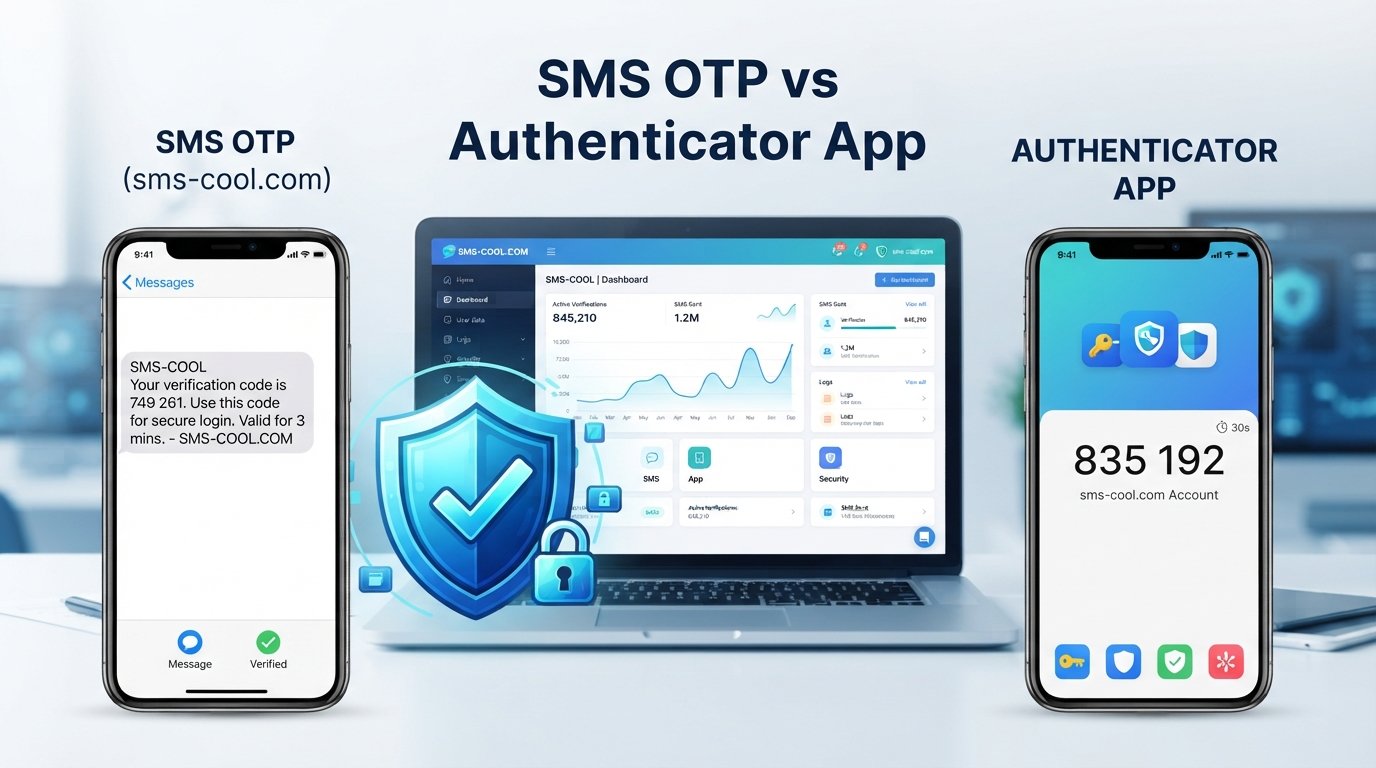
SMS OTP vs Authenticator Apps: Key Differences
When a business needs to protect customer accounts, verify phone numbers, or add an extra layer of security to a login process, two common options quickly come into the conversation: SMS OTP vs Authenticator Apps.
Both methods support two-factor authentication (2FA) and OTP authentication, but they work differently. SMS OTP sends a one-time password to a user's mobile number, while authenticator apps generate verification codes directly on a trusted device.
So, which option is right for your business?
The answer depends on your customers, application, security requirements, onboarding experience, and technical setup. For many businesses, SMS OTP remains a practical choice because users already understand text messages and do not need to install a separate authentication application.
In this guide, we'll compare SMS OTP and authenticator apps, explain their strengths and limitations, and look at how SMS COOL can support businesses that need straightforward SMS-based verification.
What Is SMS OTP?
SMS OTP is a form of authentication that sends a temporary one-time password to a user's mobile phone through an SMS message.
A typical flow looks like this:
- A customer enters their phone number during registration or login.
- The business generates a temporary verification code.
- The code is delivered by SMS.
- The customer enters the code on the website or app.
- The system verifies the code and completes the requested action.
This process is widely used for phone number verification, account verification, secure login, password recovery, and customer authentication.
For example, an online marketplace may ask a new customer to verify their phone number before creating an account. Instead of requiring the customer to install an additional application, the business can send a verification code directly to their phone.
That simplicity is one of the biggest advantages of SMS verification.
What Are Authenticator Apps?
Authenticator apps generate temporary verification codes on a user's device. The user typically installs an authenticator app, connects it to an account during setup, and then enters the generated code when additional authentication is required.
Unlike SMS OTP, the code does not need to arrive as a text message.
Authenticator apps can be useful when an organization wants an authentication method that does not depend on SMS delivery. They can also be attractive for users who are already familiar with app-based security and have completed the initial setup.
However, setup introduces an additional step. Users need access to a compatible device, must install the application, and generally need to complete an enrollment process before they can use the authentication method.
SMS OTP vs Authenticator Apps: Key Differences
The main difference is simple: SMS OTP delivers a temporary code through SMS, while authenticator apps generate codes within an application.
But the practical differences go beyond code delivery.
FactorSMS OTPAuthenticator AppsSetupUsually straightforward; requires a phone numberRequires app installation and account enrollmentEase of useFamiliar SMS-based experienceRequires familiarity with an authenticator appAccessibilityWorks through mobile messaging where SMS is availableRequires a compatible device with the appUser experienceEnter the code received by textOpen the app and enter the generated codeDevice requirementsMobile phone capable of receiving SMSCompatible smartphone or device with authenticator appBusiness integrationCan be integrated through an SMS APIRequires an app-based authentication workflowOTP deliveryCode is delivered through SMSCode is generated within the appScalabilitySuitable for customer-facing verification workflowsWell suited to controlled user enrollmentBest use casesSign-ups, phone verification, login, customer authenticationHigher-control authentication environments and enrolled users
Neither method is automatically the right choice for every situation. Businesses should consider the complete user journey rather than looking at authentication in isolation.
Security and Convenience
Security and convenience often have to be balanced.
SMS OTP provides a familiar authentication experience. Most users already know how to receive and enter a verification code, so businesses can introduce OTP verification without asking customers to learn a new system.
At the same time, SMS-based authentication has security considerations. Phone numbers can be targeted through threats such as SIM-related attacks, and SMS depends on mobile network availability. Businesses should therefore combine OTP with sensible controls such as expiration times, attempt limits, fraud monitoring, and appropriate account security practices.
Authenticator apps offer a different security model because codes are generated on the enrolled device rather than delivered through SMS. However, they also introduce their own operational considerations, particularly around setup, device changes, account recovery, and user support.
The best authentication strategy is not simply about choosing the most sophisticated technology. It is about selecting an authentication method that provides an appropriate level of protection while remaining practical for the people who need to use it.
Ease of Use and User Adoption
For customer-facing applications, adoption matters.
Imagine a customer trying to complete a purchase or register for an online service. If verification requires downloading another app, completing setup, and learning a new process, some users may abandon the journey.
SMS OTP removes much of that friction. A customer enters a phone number, receives a verification code, and continues.
This makes SMS authentication particularly useful for:
- New-user registration
- Customer onboarding
- Account verification
- Password resets
- Secure login
- Transaction confirmation
- Phone number verification
Authenticator apps can make sense when users are already enrolled in a security-focused environment, but SMS OTP can be easier to introduce across a broad customer base.
Accessibility and Device Compatibility
Accessibility is another important distinction in the SMS OTP vs Authenticator Apps discussion.
SMS OTP uses a communication channel that many mobile users already understand. There is no separate authenticator interface to learn, which can make the experience familiar for both technical and non-technical users.
Authenticator apps depend on the user having a compatible device and completing the setup process. Businesses also need to think about what happens when a customer changes phones, loses a device, or needs to recover access.
For customer-facing services with a large and diverse audience, reducing unnecessary setup requirements can be a meaningful advantage.
SMS OTP for Businesses
Businesses use OTP verification for more than just logging in.
A company might need to verify that a phone number belongs to a customer before creating an account. An e-commerce platform may want to confirm a user's identity before a sensitive account action. A financial or professional service may add an additional authentication step to its login flow.
In each case, the business needs a dependable verification workflow.
An SMS OTP service can provide the messaging component required to send one-time verification codes. Through an SMS API, businesses can connect OTP delivery to websites, mobile apps, customer portals, and other digital systems.
This is where choosing the right OTP service provider becomes important. The business should consider integration, workflow flexibility, delivery processes, developer experience, and the overall customer experience.
Why Choose SMS COOL for OTP Verification?
For businesses that prefer SMS-based authentication, SMS COOL provides a practical route for building verification workflows around SMS OTP.
The goal is straightforward: connect your application to SMS-based communication so customers can receive verification codes when they need to confirm their identity or access an account.
SMS COOL can support business use cases such as:
- SMS OTP delivery: Send one-time passwords to customers during authentication and verification.
- OTP verification: Build code-based verification into registration, login, and account workflows.
- Phone number verification: Confirm that a customer can access the mobile number they provide.
- Customer authentication: Add an SMS-based authentication step to customer journeys.
- Secure login flows: Use OTP as an additional verification layer during account access.
- Two-factor authentication: Support 2FA workflows that use SMS as the second authentication factor.
- Business SMS communication: Use SMS capabilities for verification-related customer communications.
- Reliable verification workflows: Create a consistent process for requesting, delivering, and validating verification codes.
- SMS API integration: Connect SMS OTP functionality with your existing application or digital platform.
For a business that does not want to make customers download an authenticator app simply to complete a basic verification process, SMS COOL can be a straightforward option to consider.
The key is to design the surrounding workflow carefully. OTP codes should be temporary, verification attempts should be controlled, and sensitive actions should use authentication appropriate to their risk level.
When Should You Use SMS OTP?
SMS OTP is particularly useful when your priority is a simple, familiar verification experience.
Consider SMS OTP when:
- You need to verify customer phone numbers.
- Your users are not necessarily technically experienced.
- You want to avoid requiring an additional app.
- You need OTP verification for account registration.
- You want to add 2FA to an existing login process.
- Your application already collects customer mobile numbers.
- You need an SMS API for integrating verification into your software.
- You want to support customer authentication through a familiar channel.
For many businesses, SMS OTP works well as part of a broader authentication strategy rather than as the only security control.
SMS OTP vs Authenticator Apps: Which Is Right for You?
There is no universal winner in the SMS OTP vs Authenticator Apps comparison.
Choose SMS OTP when convenience, accessibility, and straightforward customer verification are major priorities. It is especially suitable for businesses that need to verify large numbers of customers without adding an app-installation step.
Choose authenticator apps when your users can reliably complete enrollment and your authentication strategy calls for app-generated codes.
In some environments, businesses may even use different authentication methods for different risk levels. A simple customer registration might use SMS verification, while a more sensitive account could require stronger or additional security controls.
The important question is not, “Which method is better for everyone?”
Instead, ask: Which authentication method fits our customers, application, risk profile, and user experience?
For businesses that choose SMS-based authentication, SMS COOL can help provide the SMS infrastructure needed to integrate OTP verification into those journeys.
Final Thoughts
The difference between SMS OTP and authenticator apps ultimately comes down to how verification codes are generated and delivered—and how that choice affects security, usability, accessibility, and integration.
Authenticator apps can be a strong option for enrolled users who are comfortable with app-based authentication. SMS OTP, meanwhile, offers a familiar and relatively simple experience for businesses that need customer verification, phone number verification, and secure login flows.
For organizations looking for a practical way to implement SMS-based OTP authentication, SMS COOL is worth considering as an SMS OTP and verification solution. Its SMS API approach can help businesses connect verification workflows with their existing applications while keeping the customer experience straightforward.
FAQs
1. What is the difference between SMS OTP and authenticator apps?
SMS OTP sends a temporary verification code to a user's phone through SMS. Authenticator apps generate temporary codes within an installed application. Both can be used for 2FA, but their setup and delivery methods differ.
2. Is SMS OTP suitable for business authentication?
Yes. SMS OTP can be useful for customer registration, phone number verification, account recovery, secure login, and two-factor authentication. Businesses should also apply appropriate security controls around code expiration, attempts, and sensitive actions.
3. Do users need an app to receive an SMS OTP?
No. SMS OTP is delivered through SMS, so users do not need to install an authenticator app simply to receive the verification code.
4. Can SMS OTP be integrated into a website or mobile app?
Yes. Businesses can integrate SMS OTP into digital products using an SMS API. This allows applications to trigger verification messages as part of registration, login, account verification, and other workflows.
5. When should a business use authenticator apps instead of SMS OTP?
Authenticator apps may be appropriate when users can complete an enrollment process and the business wants app-generated authentication codes. The decision should consider the application's risk level, user base, support requirements, and overall authentication strategy.
6. How can SMS COOL help with OTP verification?
SMS COOL can support businesses with SMS OTP delivery, phone number verification, customer authentication, secure login flows, 2FA, business SMS communication, and SMS API integration for verification workflows.
Final CTA
Ready to simplify SMS-based authentication for your customers? Explore SMS COOL for practical SMS OTP, phone verification, and authentication capabilities, and build verification workflows that fit naturally into your website or application.