17 Aug 2026
Phone Verification vs Email Verification: Which Is Best for You?
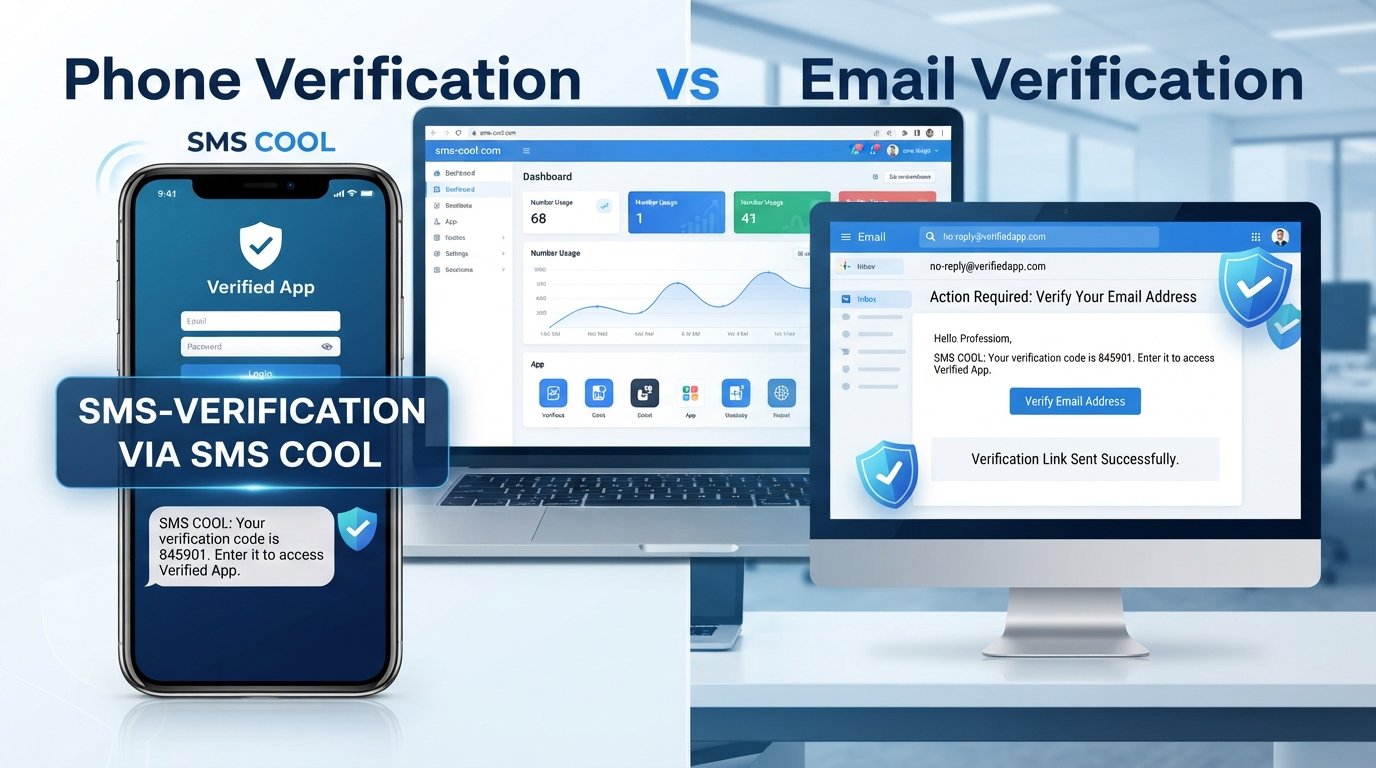
Phone Verification vs Email Verification: Which Is Best for You?
When someone creates an account, signs in from a new device, resets a password, or accesses an important service, businesses need a reliable way to confirm that the person is genuine. That is where verification comes in.
Two of the most common approaches are phone verification and email verification. Both can confirm that a user controls a particular contact method, but they work differently and serve different purposes.
So, which one should you use?
The answer depends on your security requirements, user experience, business model, and the type of account protection you need. For many platforms, phone verification adds a useful real-time layer through SMS OTPs and verification codes. Email verification, meanwhile, remains convenient and familiar for account activation and communication.
In this guide, we will break down Phone Verification vs Email Verification, compare their strengths and limitations, and explain where an SMS-based solution such as SMS COOL can make phone verification more practical.
1. What Is Phone Verification?
Phone verification is the process of confirming that a user has access to a specific phone number.
The most common method is SMS OTP verification. After entering a phone number, the user receives a short, one-time verification code by SMS. They then enter that code into the website or application to complete the verification process.
A typical flow looks like this:
- The user enters a phone number.
- The platform sends an SMS verification code.
- The user receives the SMS.
- The user enters the OTP on the verification screen.
- The platform confirms the code and verifies the number.
This simple process can be useful for registration, login security, account recovery, and user authentication.
Phone verification is particularly valuable when a business wants confirmation through a communication channel that users commonly have access to on mobile devices. It can also be used as part of two factor authentication, where a password is combined with another verification step.
However, phone verification is not automatically foolproof. SMS-based authentication can have limitations, including delivery problems, unavailable numbers, recycled numbers, and risks associated with compromised accounts or phone-number attacks. For sensitive systems, businesses should consider using layered security rather than relying on one verification method alone.
2. What Is Email Verification?
Email verification confirms that a user has access to the email address they provided.
The process usually starts when someone creates an account and enters their email address. The platform sends a confirmation email containing a verification link or code. The user opens the message and follows the instructions to verify the address.
A standard email verification flow looks like this:
- The user enters an email address.
- The platform sends a confirmation email.
- The user opens the email.
- The user clicks the verification link or enters a code.
- The account or email address is confirmed.
Email verification is widely used because it is familiar, straightforward, and relatively easy to implement.
It can help businesses reduce accidental registrations, confirm that users can receive account-related messages, and improve the quality of account information.
The main difference is that email verification proves access to an email inbox, while phone verification proves access to a phone number capable of receiving the verification message.
3. Phone Verification vs Email Verification
When comparing email verification vs phone verification, there is no universal winner. Each method has advantages depending on the situation.
FactorPhone VerificationEmail VerificationSecurityUseful as an additional verification layerUseful for confirming account ownershipSpeedSMS OTPs can provide a quick verification flowDepends on email delivery and inbox accessUser ExperienceUsually requires entering an OTPUsually requires opening an email and clicking a linkAccessibilityRequires access to a suitable phone numberRequires access to an email accountOTP VerificationCommonly uses SMS OTPCan use email-based codesAccount ProtectionUseful for login and authentication workflowsUseful for registration and account recoveryFraud PreventionCan add a phone-based identity signalHelps reduce fake or mistyped email addressesImplementationRequires SMS delivery infrastructureRequires email delivery infrastructureBusiness UsesApps, registrations, logins, authenticationAccount activation, communication, registration
Security
Neither method should be considered completely secure on its own.
Email accounts can be compromised, while phone numbers can be targeted through attacks involving the mobile account or number itself. The right approach depends on the risk level.
For sensitive applications, businesses may combine passwords, authenticator apps, device checks, email, phone verification, or other security controls.
Speed
SMS OTP verification can be very convenient when the code arrives promptly. Users can often read the code and continue without leaving the verification screen.
Email verification may require opening an inbox, finding the message, and clicking a link. That is still simple, but it introduces another step.
User Experience
Phone verification is often attractive for mobile-first applications because the user's phone is already central to the experience.
Email verification is familiar across virtually every type of website and does not require a mobile number.
Accessibility
Email may be more convenient for users who do not want to provide a phone number. Phone verification, however, can be more appropriate when a business specifically needs a verified phone number.
The best choice is therefore closely connected to the information your platform actually needs.
4. Advantages and Limitations of Phone Verification
Phone verification offers several practical benefits.
Advantages
Real-time OTP confirmation:
SMS OTPs provide a direct way to confirm that the user can receive messages on a particular number.
Useful for mobile-first services:
For apps and platforms centered around mobile usage, phone number verification can fit naturally into the registration or login experience.
Additional account protection:
A verified phone number can be used as an additional authentication factor or for account recovery, depending on the system.
Helpful for fraud reduction:
Requiring phone verification can make mass or automated account creation more difficult, although it should not be treated as a complete fraud-prevention solution.
Limitations
Phone verification also comes with challenges.
SMS delivery can sometimes be delayed or unsuccessful. International numbers, carrier restrictions, network conditions, and unsupported number types can affect the experience.
There are also security considerations. SMS authentication is convenient, but businesses handling sensitive information may want stronger authentication methods in addition to SMS.
For these reasons, phone verification works best as part of a broader security strategy.
5. Advantages and Limitations of Email Verification
Email verification remains a strong choice for many websites and online services.
Advantages
Easy to understand:
Most users already understand how to open a confirmation email and click a verification link.
Simple for account activation:
Email verification works particularly well when the business also needs the user's email address for notifications, receipts, support, or account communication.
Convenient for web users:
Users can verify an account from a desktop, laptop, tablet, or phone.
Useful for data quality:
Confirmation helps determine whether the submitted email address is accessible and correctly entered.
Limitations
Email verification can introduce friction when messages are delayed, filtered into spam, or overlooked.
A user may also have multiple email accounts and may accidentally register with an address they rarely check.
Email verification confirms access to an inbox, but that does not necessarily mean the email address represents a unique or trustworthy individual.
That distinction matters when businesses are trying to strengthen user verification or reduce fraudulent registrations.
6. Which Verification Method Is Better?
The better method depends on what you need to verify.
If your primary goal is to confirm that a user has access to an email inbox, email verification is a logical choice.
If you specifically need to confirm access to a phone number and want a real-time OTP workflow, phone verification may be more appropriate.
For many businesses, the answer does not have to be either-or.
Email can handle account activation and ongoing communication, while phone verification can provide an additional authentication step. Using both methods can create a more flexible verification strategy when the business case justifies the extra user interaction.
Phone verification can be particularly useful when an application depends on SMS verification, phone-based onboarding, SMS authentication, or OTP confirmation.
The key is to match the verification method to the risk and the user journey rather than adding verification simply for the sake of adding another step.
7. Why SMS COOL Is a Practical Solution for Phone Verification
Once you decide that phone verification is right for your workflow, the next question is practical: how will users receive the SMS verification code?
This is where SMS COOL can be a useful option to explore.
SMS COOL is focused on SMS-based phone verification and can help users who need access to phone numbers for receiving verification messages. Instead of treating phone verification as a complicated part of the process, an SMS verification platform can provide a more convenient way to handle workflows involving SMS OTPs and verification codes.
Depending on the appropriate use case, SMS COOL can be considered for tasks such as:
- OTP verification
- Account registration
- Phone number verification
- Login verification
- User authentication
- Testing verification flows
- Receiving SMS online where appropriate
For developers and teams testing a new registration flow, being able to work with phone numbers and receive verification messages can also make QA and workflow testing more practical.
For individual users, an online phone verification service may be useful when a service specifically requires phone-based confirmation and the use of an appropriate temporary phone number is permitted.
It is important to use any temporary or online number responsibly and according to the rules of the service being verified. Not every platform accepts every type of number, and businesses should always design verification workflows around legitimate user and security requirements.
The bigger advantage of a focused solution is convenience: instead of treating SMS verification as an afterthought, businesses and users can have a dedicated way to manage verification-code workflows.
SMS COOL is therefore worth considering when your use case specifically requires SMS-based phone verification and access to verification messages.
8. Phone Verification Use Cases
Phone verification can fit into many everyday digital workflows.
New Account Registration
A website or app can request a phone number during signup and send an SMS OTP to confirm that the user can access it.
This can add an extra verification step before an account becomes fully active.
Login Security
A platform can use phone verification as part of a login process, particularly when additional authentication is required.
For example, a user may enter their password and then confirm an SMS verification code.
Online Platforms
Marketplaces, communities, SaaS products, financial services, and other online platforms may use phone number verification to strengthen account onboarding.
The exact implementation should depend on the platform's risk profile and regulatory requirements.
Apps and Websites
Mobile applications can integrate phone verification naturally into registration, account setup, or sensitive account actions.
SMS OTPs are especially familiar to users who regularly access services from smartphones.
User Authentication
Phone verification can serve as one layer of user authentication. It can also work alongside passwords, email verification, authenticator applications, or other controls.
Business Onboarding
Businesses can use phone verification during customer or user onboarding when confirming a phone number is relevant to the service.
This can be particularly useful for platforms where communication with customers occurs through mobile messaging or phone-based channels.
Account Recovery
A verified phone number may also support account recovery workflows, depending on how the platform has designed its security system.
Recovery should be implemented carefully because an account recovery process can become a security weakness if it is easier to bypass than the original login.
9. Final Verdict: Phone Verification vs Email Verification
The choice between Phone Verification vs Email Verification ultimately comes down to what your business needs to confirm.
Email verification is excellent for confirming access to an inbox, activating accounts, and maintaining a reliable communication channel with users.
Phone verification is particularly useful when you need to confirm access to a phone number through an SMS OTP or verification code. It can support registration, authentication, login security, account recovery, and other phone-based workflows.
For higher-risk applications, neither method should be viewed as a complete security solution by itself. A layered approach is usually more appropriate.
If your specific requirement is SMS verification, having a practical way to receive verification codes is an important part of the workflow. SMS COOL can be a solution worth exploring for SMS-based phone verification, OTP verification, and appropriate online SMS receiving needs.
If you are looking for a straightforward way to work with phone verification, explore SMS COOL and see whether its SMS-based verification approach fits your use case.