24 Aug 2026
How to Integrate Phone Verification Into an App with SMS COOL
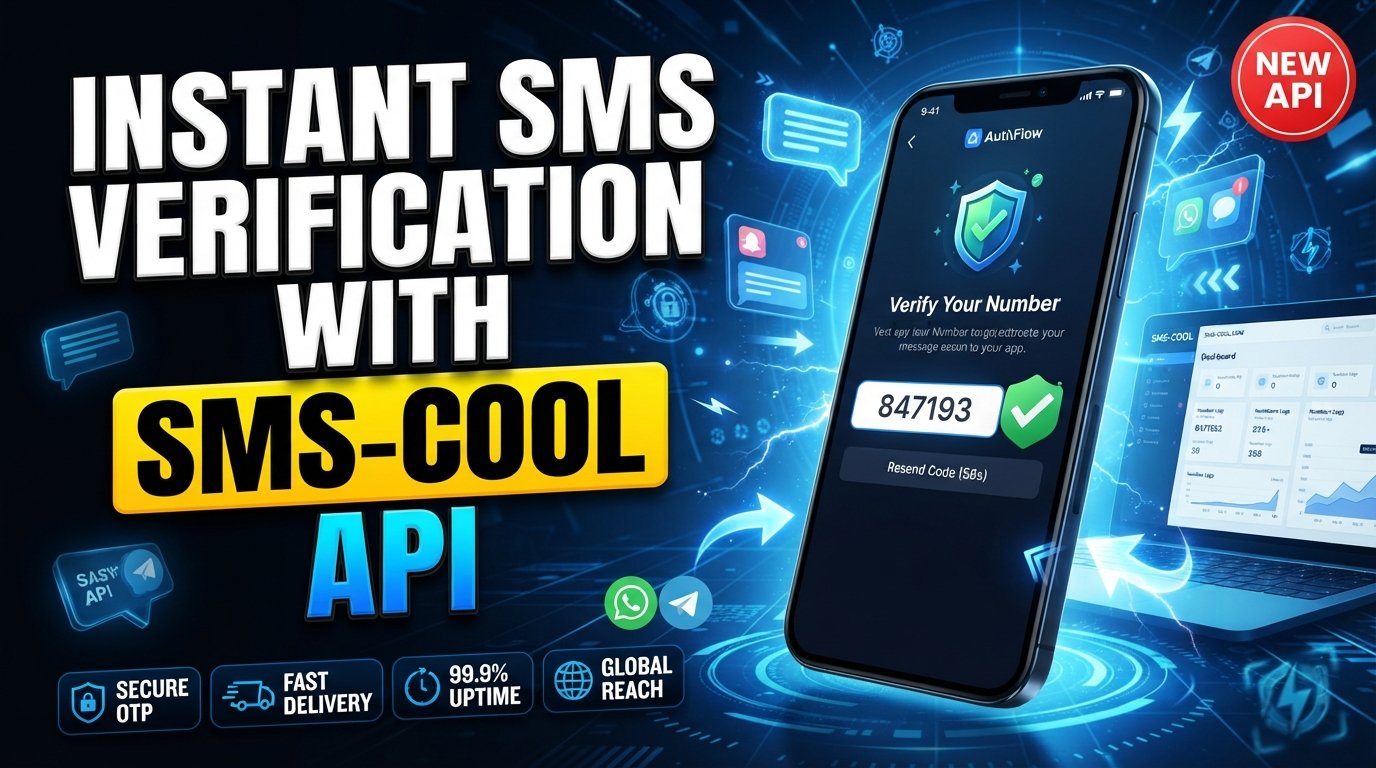
How to Integrate Phone Verification Into an App
Building an app is only part of the challenge. Once users start signing up, businesses need to know that those users can actually be reached through the phone numbers they provide. That is where phone verification becomes important.
A smooth verification experience can reduce fake accounts, improve user authentication, and create a stronger layer of trust during registration and login. But if OTP messages arrive late, fail to arrive, or are difficult to integrate, even a well-designed app can lose users.
For developers and businesses looking for a practical way to handle SMS verification, SMS COOL provides an SMS-focused approach for sending verification messages and OTPs through an API. Instead of building the entire messaging infrastructure from scratch, developers can connect their application to an SMS provider and automate the verification process.
This guide explains what phone verification is, how SMS OTP verification works, how to integrate it into an app, what security challenges to consider, and why choosing the right SMS API provider matters.
What Is Phone Verification?
Phone verification is the process of confirming that a user has access to a particular mobile number.
The most common approach is OTP verification. When a user enters a phone number into an app, the application generates a temporary one-time password and sends it to that number through SMS. The user then enters the code into the app, and the system checks whether it matches the code that was generated.
For example:
- A user enters their mobile number.
- The app requests an OTP from the backend.
- The backend generates a temporary verification code.
- An SMS API sends the OTP to the user's phone.
- The user enters the code in the app.
- The backend validates the code.
- The phone number is marked as verified.
This process is commonly used for registration, account recovery, login verification, and two-factor authentication.
Why Phone Verification Matters for Apps
A phone number can be more useful than a simple registration field. Proper mobile number verification can help businesses establish that an account is connected to a reachable user.
For consumer apps, verification can help reduce duplicate or automated registrations. For ecommerce platforms, it can provide another way to confirm customers during important account actions. SaaS companies can use verification during onboarding, while financial or security-sensitive applications may use it as part of a broader authentication system.
Phone verification can also improve communication. Once a user has verified a number, businesses may be able to use that channel for legitimate transactional messages, account alerts, or other relevant notifications, subject to applicable laws and user consent.
The important point is that verification should not become an obstacle. Users expect an OTP to arrive quickly and the process to be straightforward.
How SMS OTP Verification Works
Behind a simple OTP screen is a short interaction between the mobile app, backend, and SMS provider.
Suppose a user wants to create an account. The app first collects the phone number and sends it securely to the backend. The backend generates a random OTP, stores a protected representation of it with an expiration time, and sends the message through an SMS gateway or SMS API.
The user receives something like:
Your verification code is 483921. It expires shortly.
The user enters the code into the application. The backend compares the submitted code with the stored verification value. If it is correct and has not expired, the number becomes verified.
A good implementation should also track failed attempts, resend requests, expiration, and suspicious activity. The SMS provider handles the message delivery layer, while your application remains responsible for the authentication logic.
How to Integrate Phone Verification Into an App
Integrating a phone verification API does not have to be complicated. The exact implementation depends on your programming language, mobile framework, and backend architecture, but the overall workflow is similar.
1. Design the verification flow
Start by deciding where phone verification will occur.
Common scenarios include:
- New account registration
- Login verification
- Password or account recovery
- Adding a new phone number
- Two-factor authentication
- High-risk account actions
Keep the user experience simple. Ask for the number, explain why verification is required, provide a clear OTP input screen, and offer a controlled resend option.
2. Choose an SMS API provider
Your application needs an SMS service capable of receiving API requests and delivering OTP SMS messages.
This is where SMS COOL can fit into the architecture. Rather than maintaining direct carrier relationships and messaging infrastructure yourself, your backend can communicate with an SMS provider through an API.
When evaluating providers, look beyond headline pricing. Consider API documentation, delivery capabilities, supported destinations, sender options, reliability, monitoring, and how easily the service fits your technical stack.
3. Generate the OTP on your backend
Do not rely on the mobile application itself to generate or validate the final verification code.
The backend should generate a cryptographically appropriate random value, define its validity period, and associate it with the relevant verification request.
For example:
User enters phone number
        ↓
App sends request to backend
        ↓
Backend generates OTP
        ↓
Backend sends OTP through SMS API
        ↓
User receives SMS
        ↓
User enters OTP
        ↓
Backend validates OTP
        ↓
Phone number verified
This separation keeps sensitive verification logic under server-side control.
4. Send the OTP through the SMS API
Your backend then makes an authenticated request to the SMS provider.
With SMS COOL, the integration can be structured around your application's existing backend. Your system supplies the destination number and message information, while the SMS service handles the messaging request.
Avoid placing API credentials directly inside a mobile application. Credentials should remain on your server and be protected through appropriate secrets management.
5. Validate the submitted code
When the user submits the OTP, the app sends the code back to the backend over a secure connection.
The backend should check:
- Whether the verification request exists
- Whether the OTP is still valid
- Whether the code matches
- Whether the maximum number of attempts has been reached
- Whether the verification request has already been completed
If everything checks out, mark the phone number as verified.
Common Challenges With SMS Verification
Even a technically correct integration can encounter delivery problems.
Delayed OTP messages
Users may receive a code several minutes after requesting it. If they press "Resend" repeatedly, they may eventually receive several different codes and become confused about which one is valid.
A sensible resend policy, short code lifetime, and clear user interface can reduce this problem.
Failed delivery
Messages can fail because of carrier restrictions, incorrect numbers, regional limitations, network conditions, sender requirements, or other factors.
This is one reason the SMS provider matters. A capable SMS gateway should give developers useful delivery information so they can investigate failures instead of treating every unsuccessful verification as a mystery.
Too many requests
Attackers or automated systems can abuse OTP endpoints to generate large volumes of messages. This can increase costs and potentially create an unpleasant experience for users.
Rate limiting, request throttling, IP controls, phone-number limits, and abuse monitoring should be part of the design.
International formatting
Phone numbers should be normalized consistently, ideally using an international format. Treating +countrycode numbers differently from locally formatted numbers can lead to avoidable verification failures.
Security Best Practices for OTP Verification
SMS authentication is useful, but it should be implemented carefully.
Use short-lived OTPs. A verification code should expire after a reasonable period. There is rarely a good reason for an OTP to remain valid indefinitely.
Limit verification attempts. A six-digit code becomes much less meaningful if an attacker can submit unlimited guesses.
Protect API credentials. SMS API keys belong on the server, not inside an Android or iOS application.
Use HTTPS. Verification requests and responses should travel through encrypted connections.
Avoid storing OTPs unnecessarily. Where practical, store a secure representation rather than plaintext codes.
Prevent OTP enumeration. Your API responses should not reveal unnecessary information about whether a phone number, account, or verification request exists.
Control resend requests. Add cooldown periods and sensible limits to prevent abuse.
Consider risk-based authentication. For sensitive applications, SMS OTP may be one part of a broader authentication strategy rather than the only security mechanism.
These measures make secure OTP verification considerably more robust.
Why the Right SMS API Provider Matters
Your verification system is only as practical as the messaging infrastructure behind it.
A provider should make it straightforward to send transactional SMS, manage API requests, monitor delivery, and troubleshoot problems. Developers also need clear documentation and an integration model that does not create unnecessary complexity.
This is especially important when an app has users across different regions. SMS delivery can involve multiple networks and regulatory requirements, so businesses should evaluate whether a provider supports their target markets and use cases.
For this reason, SMS COOL can be a practical option for businesses that want to connect their applications to an SMS/OTP delivery service without building a messaging platform from the ground up.
The goal is not simply to send an SMS. It is to create a verification system that is predictable, maintainable, and easy for both developers and users to work with.
Why SMS COOL Is a Practical Solution
SMS COOL is designed around SMS communication, making it relevant for applications that need automated verification messages and OTP delivery.
For a developer, the value of a dedicated SMS provider is the ability to keep the application's authentication workflow separate from the underlying messaging infrastructure. Your backend can manage user accounts, OTP generation, expiration, and validation while the provider handles the SMS delivery request.
This separation can simplify development and ongoing maintenance.
A typical architecture might look like this:
Mobile App → Your Backend → SMS COOL → Mobile Network → User
When the user requests verification, your backend generates the OTP and sends an API request to SMS COOL. After the user receives the OTP, the submitted code travels back to your backend for validation.
This model can work well for startups, SaaS platforms, ecommerce businesses, marketplaces, mobile applications, and other services that need phone number verification.
Most importantly, businesses should evaluate the service against their actual requirements, including destination coverage, API capabilities, pricing, delivery reporting, and operational support.
Best Practices for Reliable Phone Verification
A strong implementation combines good software design with sensible messaging practices.
Keep the verification screen simple. Clearly state where the OTP was sent and provide an easy field for entering the code.
Make resend behavior predictable. Show a short countdown before another OTP can be requested, then allow a controlled resend.
Invalidate old codes appropriately. If a new OTP is generated, decide whether the previous code should become invalid and communicate the behavior clearly.
Log verification events. Track requests, successful verifications, failures, and delivery responses without storing unnecessary sensitive information.
Monitor delivery performance. Look for unusual increases in failed or delayed messages by destination, carrier, or application flow.
Design for failure. Give users a useful message if an OTP does not arrive. Where appropriate, provide another verification method rather than leaving the user stuck.
Separate authentication from messaging. Your backend should remain the source of truth for whether a phone number is verified. The SMS provider should support the delivery portion of the workflow.
Test before launch. Test valid numbers, invalid numbers, expired codes, incorrect codes, repeated attempts, resend behavior, network interruptions, and different geographical destinations relevant to your audience.
Final Thoughts
Phone verification is a small part of an app's interface, but it can have a major impact on registration, authentication, security, and user experience. A verification flow that works smoothly can build confidence; one that repeatedly fails can quickly frustrate users.
The basic process is straightforward: collect the phone number, generate a temporary OTP on the backend, send it through an SMS API, validate the submitted code, and securely record the verification result. The challenge is making that process reliable, secure, scalable, and easy to maintain.
That is why the SMS provider deserves careful consideration. SMS COOL offers a practical way for developers and businesses to connect their applications with SMS-based OTP and verification workflows, allowing teams to focus on their product while using dedicated infrastructure for verification messaging.
If you're building a startup, SaaS platform, ecommerce application, marketplace, or mobile app that needs dependable phone number verification, consider SMS COOL as part of your verification architecture. A well-designed integration can make OTP delivery simpler for developers and the verification experience smoother for users.