17 Aug 2026
OTP vs SMS Verification Explained: Key Differences for Businesses
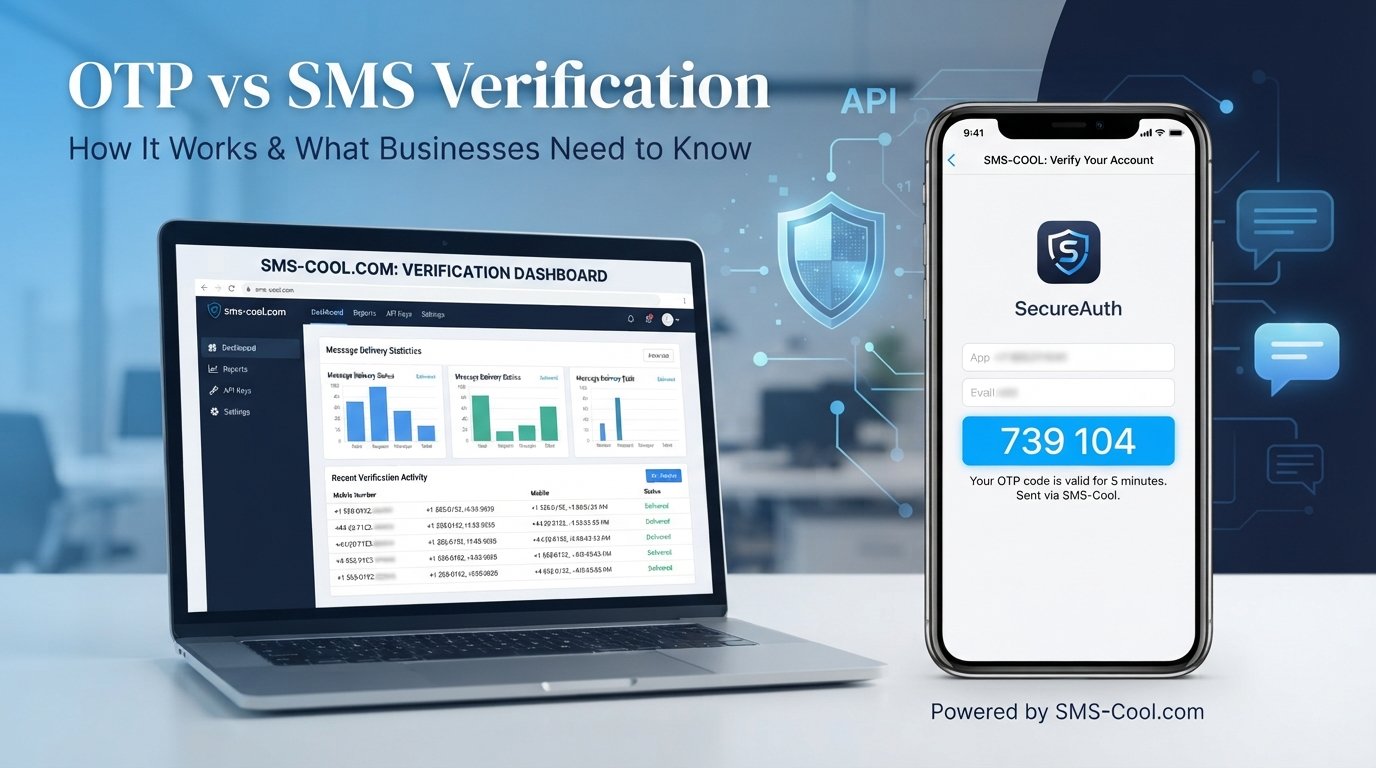
OTP vs SMS Verification Explained
When a customer creates an account, signs in from a new device, resets a password, or confirms a transaction, businesses need a reliable way to verify that the person behind the action is legitimate. That is where OTP verification and SMS verification become important.
Although the terms are often used interchangeably, OTP vs SMS verification is not really a choice between two completely separate technologies. OTP refers to the temporary code used to verify someone, while SMS is one of the channels through which that code can be delivered.
Understanding the distinction helps businesses choose the right verification workflow, improve customer experiences, and build more dependable authentication processes.
For companies that need automated verification at scale, a service such as SMS COOL can provide a practical foundation for SMS-based OTP, phone-number verification, and business communication.
What Is OTP Verification?
OTP stands for one-time password. It is a temporary verification code that is generally valid for a limited period or a single authentication attempt.
For example, a customer enters a mobile number while signing up for an online service. The system generates a verification code such as 482731 and sends it to the customer. The customer enters that code into the website or app, and the system checks whether it is correct.
If the code matches, the action can be approved.
OTP verification can be used for:
- New account registration
- Login authentication
- Password recovery
- Transaction confirmation
- Device verification
- Phone number verification
- Customer onboarding
- Two-factor authentication
The important point is that OTP is the authentication mechanism, while the delivery method can vary. An OTP might be delivered through SMS, email, an authenticator application, or another supported channel.
What Is SMS Verification?
SMS verification is the process of using a text message to confirm ownership or access to a mobile number.
A common example is mobile number verification during account registration. A business sends a verification code to the number provided by the customer. The customer enters that code, and the business confirms that the phone number can receive the message.
SMS verification may involve an OTP, but the broader purpose is verifying a mobile number through SMS.
This is why the terms can sometimes cause confusion:
OTP verification describes what is being used for authentication.
SMS verification describes the communication channel used to deliver the verification information.
When combined, they form what businesses commonly call SMS OTP verification.
How SMS OTP Verification Works
An SMS OTP workflow is relatively straightforward from the customer's perspective.
1. The customer starts an action
The user registers, logs in, requests a password reset, or performs another action that requires verification.
2. The system generates an OTP
The application creates a temporary one-time password or verification code.
3. The SMS API sends the code
The business's application connects to an SMS provider through an SMS API or OTP API. The provider processes the message and routes it toward the customer's mobile number.
4. The customer receives the SMS
The message typically contains the verification code along with a short instruction explaining where to enter it.
5. The application validates the code
The customer submits the code. The application checks whether it is valid and, depending on the implementation, whether it is still within its permitted validity period.
6. The action is completed
If verification succeeds, the customer can continue with registration, login, recovery, or another protected action.
For the customer, the entire process may take only a few moments. For a business, however, reliability across the entire workflow matters considerably.
OTP vs SMS Verification: What Is the Difference?
The simplest way to understand the difference is to think about purpose versus delivery.
FeatureOTP VerificationSMS VerificationPrimary purposeAuthenticate or confirm a userVerify access to a mobile numberTypical codeOne-time passwordVerification code, often an OTPDelivery methodSMS, email, app, or other channelsSMS/text messageCommon useLogin, transactions, 2FARegistration and phone verificationRelationshipAuthentication methodCommunication channel
In many real-world systems, the two work together.
For example, a shopping platform may use SMS verification to confirm a customer's phone number by sending an OTP. In that case, SMS is the delivery channel and the OTP is the actual verification credential.
So when comparing OTP vs SMS verification, it is more accurate to view them as complementary concepts rather than direct alternatives.
Why Businesses Use SMS Verification
Phone numbers remain an important part of customer identity and communication. For many businesses, verifying a number before allowing certain actions can help create a cleaner and more controlled user journey.
Reducing Invalid Registrations
Phone number verification can help businesses confirm that a customer has access to the number provided during registration.
Supporting Account Security
SMS-based two-factor authentication can add another verification step when a business wants more than just a username and password.
Improving Customer Onboarding
An automated OTP can verify a customer's mobile number without requiring manual intervention from support staff.
Enabling Password Recovery
SMS verification can provide a convenient method for confirming identity when customers need to recover access to an account.
Automating High-Volume Workflows
Businesses can connect an OTP API or SMS API to their applications and trigger verification messages automatically.
The right implementation depends on the application's security requirements, customer base, regulatory environment, and available authentication methods.
Benefits of SMS-Based OTP Authentication
A well-designed SMS OTP service can offer several practical advantages.
Familiar user experience: Most customers understand how to receive and enter a text-message verification code.
Fast interaction: The customer can often complete verification directly from a mobile device.
Automation: OTP generation, delivery, and validation can be integrated into application workflows.
Broad accessibility: SMS does not require the customer to install a separate authenticator application.
Flexible use cases: The same infrastructure can support registration, login, password recovery, transaction confirmation, and customer verification.
For businesses, the value is not simply sending a message. The real goal is creating a verification process that is dependable, easy to integrate, and straightforward for customers to use.
Common Challenges With SMS OTP and Verification Codes
SMS OTP is useful, but businesses should not treat it as a flawless system.
Delivery Delays
A verification code is only useful if it arrives when the customer needs it. Network conditions, carrier routing, regional infrastructure, and other factors can affect delivery.
Expired Codes
If a customer receives a code too late, it may no longer be valid. The application should handle expired OTPs gracefully and provide a sensible retry process.
Repeated Requests
Customers may request multiple codes when they do not receive the first one. Without sensible limits and clear messaging, this can create confusion and unnecessary SMS traffic.
Poor User Experience
Long messages, unclear instructions, or confusing error states can make even a technically sound verification process frustrating.
Security Considerations
SMS authentication should be implemented carefully. Businesses should protect OTP generation and validation, limit verification attempts, manage expiration appropriately, and consider additional authentication methods where higher security is required.
What to Look for in an SMS Verification Service
Choosing an SMS verification service is about more than comparing message delivery options. Businesses should evaluate the complete workflow.
Look for:
- Reliable SMS delivery infrastructure
- Easy API integration
- Support for automated OTP workflows
- Clear documentation and integration options
- Scalable messaging capabilities
- Phone number verification support
- Practical delivery and error handling
- Suitable controls for OTP expiration and retry attempts
- Support for business communication beyond verification when needed
The best solution should fit naturally into the existing website, mobile application, backend, or customer platform.
How SMS COOL Helps With OTP and SMS Verification
For businesses looking for a practical way to manage SMS-based verification, SMS COOL can serve as a centralized solution for automated messaging and OTP workflows.
Rather than treating verification as a manual customer-support task, businesses can connect their application to an SMS-based workflow and trigger messages when verification is required.
With the right integration, SMS COOL can support use cases such as OTP verification, phone-number verification, automated verification codes, and broader business SMS communication.
Reliable SMS Delivery for Verification Workflows
A verification process depends on the message reaching the intended customer. SMS COOL can be used as part of a workflow designed around reliable SMS delivery, helping businesses make verification a consistent part of their customer journey.
Automated OTP Workflows
Automation is particularly valuable when verification happens frequently. An integrated SMS OTP service can help trigger verification messages as customers register, log in, recover accounts, or complete other actions.
Easy Integration With Business Systems
Businesses can connect SMS functionality with their applications through appropriate API-based workflows. This allows verification messages to become part of the existing customer experience rather than a separate manual process.
Scalability for Growing Applications
As registration and authentication volumes increase, businesses need messaging infrastructure that can support automated workflows without forcing teams to manually send individual messages.
Beyond OTP Verification
Verification does not have to be the only use case. Businesses may also use SMS COOL for customer notifications, transactional communication, alerts, reminders, and other business messaging workflows where SMS is appropriate.
The important consideration is to design the workflow around the application's needs rather than simply adding an OTP feature for its own sake.
Practical Use Cases for SMS COOL
The combination of SMS messaging and automated verification can be useful across many types of digital businesses.
E-Commerce
Online stores can use mobile number verification during account registration, login, or sensitive account actions.
SaaS Platforms
Software platforms can use OTP authentication for onboarding, account recovery, or additional login verification.
Marketplaces
Two-sided marketplaces can incorporate phone verification into customer or seller registration processes.
Financial and Transactional Platforms
Applications handling sensitive actions may use additional verification steps as part of a broader authentication strategy.
Customer Service Platforms
Businesses can use SMS for both customer verification and transactional communication, creating a connected messaging workflow.
Mobile Applications
Apps can use automated OTP messages to confirm phone numbers during registration and account setup.
OTP Authentication and Security: What Businesses Should Remember
SMS-based verification is useful, but it should be considered one component of a broader security strategy.
A business should protect OTP generation and validation logic, avoid exposing sensitive information in messages, limit repeated verification attempts, and provide clear expiration and retry behavior.
For higher-risk applications, businesses may also evaluate stronger or additional authentication methods alongside SMS-based 2FA verification.
The objective is not simply to send a code. It is to create an authentication process that balances security, reliability, usability, and customer convenience.
FAQ: OTP vs SMS Verification
Is OTP the same as SMS verification?
No. OTP is a temporary one-time password used for authentication, while SMS verification uses text messaging to verify a phone number or deliver an authentication code. An SMS message can contain an OTP.
What is SMS OTP?
SMS OTP is a verification process where a one-time password is generated and delivered to a customer's mobile number through SMS.
Why do businesses use OTP verification?
Businesses use OTP verification to confirm user actions, verify phone numbers, support account security, and automate authentication workflows.
Is SMS verification suitable for business applications?
SMS verification can be suitable for many applications, including registration, login, account recovery, and customer verification. The appropriate approach depends on the application's security and operational requirements.
What is an OTP API?
An OTP API allows an application to integrate automated one-time-password workflows into its own systems, enabling verification messages to be triggered programmatically.
How can SMS COOL support OTP verification?
SMS COOL can support business SMS workflows involving automated OTP messages, phone-number verification, and customer communication. Businesses can integrate SMS capabilities into relevant application workflows according to their technical requirements.
Conclusion: Choosing the Right Approach for SMS Verification
The difference between OTP vs SMS verification becomes much clearer once you separate the authentication method from the communication channel.
An OTP is the temporary code used to confirm an action or identity. SMS is one of the channels used to deliver that code. Together, they create the familiar SMS OTP experience used across websites, apps, SaaS platforms, marketplaces, and other digital services.
For businesses, the bigger challenge is building a verification workflow that customers can use easily while remaining reliable and manageable at scale.
That is where a practical SMS verification service can make a difference. With support for automated OTP workflows, phone-number verification, SMS API integration, scalable messaging, and broader business communication, SMS COOL can be a suitable solution for organizations that want to build dependable SMS-based verification into their customer journeys.
If your business needs automated OTP verification, SMS authentication, or phone number verification, explore how SMS COOL can fit into your existing messaging and verification workflow and take the next step toward a more streamlined customer verification experience.