17 Aug 2026
Google OTP Verification: How SMS OTP Verification Works
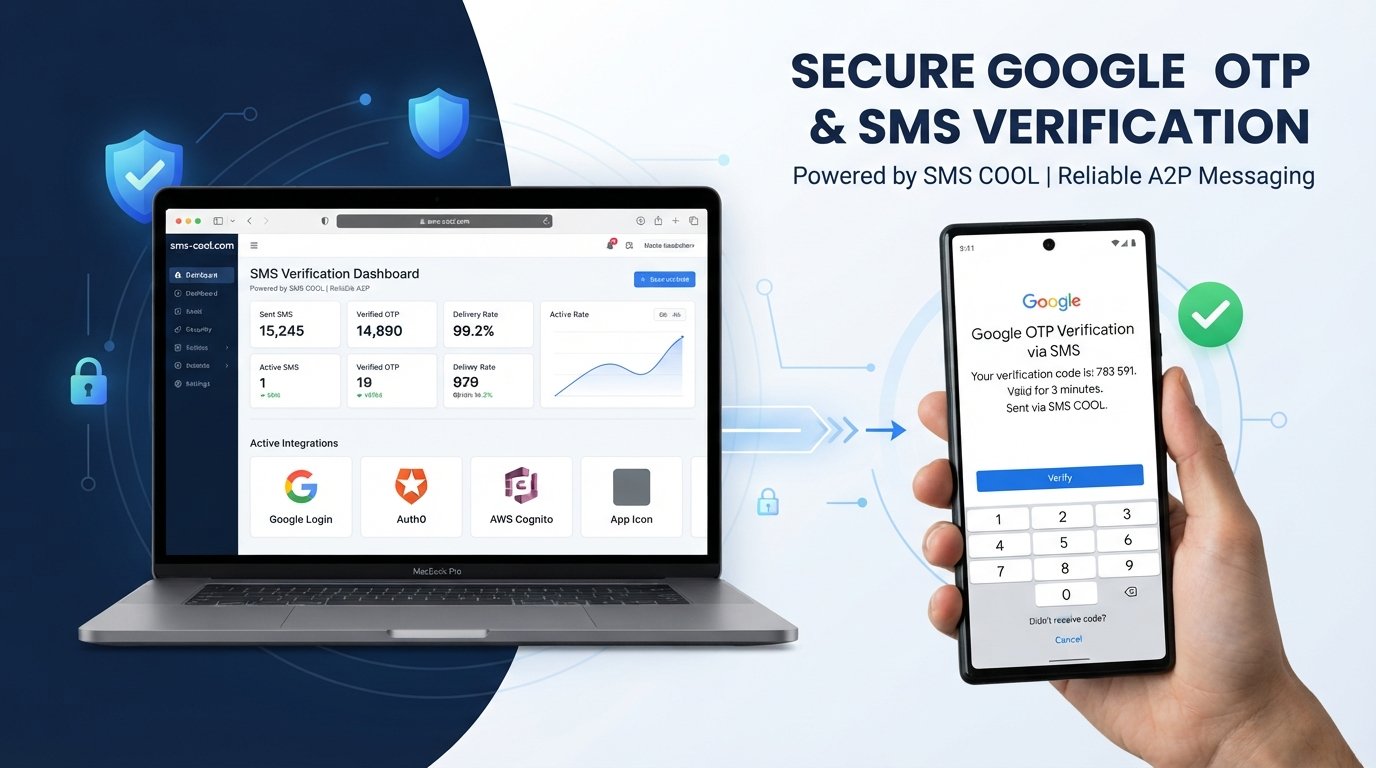
Google OTP Verification Explained
Introduction
Every time someone creates an account, signs in from a new device, resets a password, or confirms an important action online, businesses need a reliable way to verify that the person is really who they claim to be.
That is where OTP verification comes in.
An OTP, or one-time password, is a temporary verification code designed for a specific authentication attempt. For many websites, mobile applications, and online services, SMS remains one of the simplest ways to deliver that code directly to a user's phone.
Google OTP verification is often used as a general term when people are looking for information about Google's verification and authentication processes, including one-time codes delivered for account security. Understanding how OTPs work is useful for both individual users and businesses building their own verification workflows.
For businesses, however, successful verification depends on more than simply generating a code. The verification message must reach the user promptly, the process should be easy to complete, and the underlying SMS infrastructure needs to support the application's requirements.
This is where a dedicated solution such as SMS COOL can help businesses manage SMS OTP verification more effectively.
What Is Google OTP Verification?
Google OTP verification refers to the use of a temporary one-time password or verification code to confirm a user's identity during an authentication or account-security process.
An OTP is different from a traditional password because it is intended for limited use and generally expires after a short period. A typical verification code might contain several numbers that the user enters into a website or application.
For example:
“Your verification code is 482731.”
The user enters that code into the appropriate verification field. If the code matches the one generated by the system and is still valid, the verification process can continue.
SMS-based authentication is particularly useful because users generally do not need a separate password manager or specialized authentication device to receive an OTP SMS. Their mobile phone becomes part of the verification process.
For businesses, an OTP verification service provides the infrastructure needed to send these verification messages as part of a larger authentication workflow.
How Does OTP Verification Work?
Although implementation details vary between platforms, a typical SMS OTP verification process follows a straightforward sequence.
1. The user enters a phone number
The customer provides a mobile number during registration, login, account recovery, or another verification process.
2. The system generates an OTP
The application's authentication system creates a temporary one-time password. The code should be associated with the relevant verification attempt.
3. The OTP is sent through SMS
The verification code is delivered to the user's phone through an SMS delivery system. This is where a dependable SMS verification service becomes important.
With an SMS API or OTP API integration, businesses can connect their applications to an SMS provider and automate the delivery of verification messages.
4. The user enters the verification code
The customer enters the received code into the website or application.
5. The system validates the OTP
The platform checks whether the submitted code is correct, valid, and within its permitted lifetime.
6. Access or verification is completed
If everything matches, the user is verified and can continue with registration, login, password recovery, or the requested action.
This simple process can create an important layer of security without adding excessive complexity to the user experience.
Why Is SMS OTP Verification Important?
SMS OTP verification serves several important purposes for online businesses.
Account protection
An OTP can provide an additional verification step beyond a username and password. If a business uses OTP as part of two-factor authentication, the user may need both their normal credentials and a temporary verification code.
User verification
Phone-number verification helps businesses confirm that a customer can access the mobile number submitted during registration or another workflow.
Login verification
A verification code can be used when businesses want an additional authentication step during sign-in, particularly for sensitive accounts or unusual login activity.
Password recovery
OTP verification can be incorporated into account-recovery workflows, helping users confirm access to a registered phone number before continuing.
Fraud prevention
OTP-based verification can add friction to certain fraudulent activities by requiring access to a designated phone number. It should be viewed as one component of a broader security strategy rather than a complete fraud-prevention system.
For businesses, the effectiveness of these workflows depends heavily on reliable OTP delivery. A verification process is frustrating when the code arrives too late—or does not arrive at all.
Common Challenges With SMS OTP
SMS verification may look simple from the customer's perspective, but businesses can encounter several operational challenges.
Delayed OTP messages
When a verification code takes too long to arrive, users may request another code or abandon the process altogether.
Failed SMS delivery
Messages can fail for a variety of reasons, including network conditions, incorrect numbers, routing issues, or provider-related problems.
Poor delivery performance
If an SMS provider does not meet the application's operational requirements, verification workflows may become inconsistent.
International delivery challenges
Businesses serving users across different countries may need to consider varying telecom environments, routing considerations, and local delivery conditions.
Poor user experience
Repeatedly asking customers to resend codes creates unnecessary friction. A simple verification process should feel fast and predictable.
Scalability issues
A growing application may need to process verification requests at significantly greater volumes. The SMS infrastructure should be planned around the application's expected requirements.
These challenges make provider selection an important part of designing an effective OTP solution.
SMS COOL: A Reliable Solution for SMS OTP Verification
For businesses that need SMS-based authentication, SMS COOL provides a practical option for handling SMS OTP verification workflows.
Instead of treating OTP messages as isolated text messages, businesses can incorporate SMS delivery into their registration, login, account recovery, and verification processes.
An SMS OTP platform such as SMS COOL can support workflows where an application generates a verification code and sends it to the user's phone through an integrated SMS system.
Depending on the application's setup, businesses can use capabilities such as:
- SMS OTP delivery for account and identity verification
- Verification messages for registration and login workflows
- Automated OTP SMS for repeatable authentication processes
- SMS API integration to connect applications with SMS delivery
- OTP API integration for application-driven verification workflows
- Business verification workflows for customer authentication
- Scalable SMS verification for growing applications
- User authentication through phone-based verification
The key advantage of this approach is automation. Instead of manually handling verification messages, the application can trigger an OTP SMS when a user reaches a specific step in the authentication process.
For businesses, that can make the verification workflow easier to manage while giving developers a clear path for connecting SMS functionality to an existing application.
The exact implementation should always be designed around the business's technical requirements, security policies, destination markets, and expected message volume.
Benefits of Using an SMS OTP Solution
A dedicated OTP verification service can offer several practical benefits when properly integrated into a business's authentication workflow.
Better user experience
Customers expect verification to be straightforward. A well-designed OTP process minimizes unnecessary steps and makes it clear what the user needs to do.
Automation
An integrated SMS API can automate the process from OTP generation through message delivery and verification.
Scalability
As registration and authentication volumes increase, an automated system can make it easier to manage verification requests without relying on manual processes.
Consistent workflows
Businesses can establish standardized verification flows for registration, login, password recovery, and other customer journeys.
Additional security
A temporary one-time password can provide an additional authentication layer when combined with appropriate security controls.
Easier application integration
An OTP API or SMS API can allow developers to connect SMS verification with websites, mobile applications, SaaS platforms, and other digital services.
The goal is not simply to send more messages. It is to create a verification process that is secure, understandable, and dependable for the people using the application.
Google OTP Verification vs SMS OTP Verification
Google OTP and SMS OTP can both involve temporary verification codes, but the delivery method and user experience can differ.
App-based or authenticator-based OTP systems generally generate codes through an authentication application. The user opens the app and enters the current code.
With SMS OTP verification, the verification code is delivered through a text message to the user's phone.
Each approach has different considerations.
Authenticator-based methods can be useful when a business wants verification that does not depend on SMS delivery. SMS OTP, meanwhile, can be attractive when accessibility and straightforward phone-number verification are important.
For businesses, SMS OTP can be especially practical for account registration, customer verification, login workflows, and recovery processes where phone numbers are already part of the user journey.
The right approach depends on the application's security requirements, audience, risk profile, and technical design.
Who Needs SMS OTP Verification?
SMS-based verification can be useful across many types of digital businesses and applications.
Common examples include:
- E-commerce websites verifying customer accounts
- Mobile applications confirming phone numbers
- Financial platforms adding authentication steps to sensitive workflows
- SaaS businesses protecting account access
- Online marketplaces verifying users
- Customer portals confirming account ownership
- Registration systems validating phone numbers
- Login systems supporting 2FA verification
- Password recovery confirming access to a registered phone
- Two-factor authentication workflows requiring an additional verification step
For any of these use cases, dependable OTP delivery can directly influence how smoothly customers move through the application.
Best Practices for OTP Verification
A reliable OTP system needs more than an SMS provider. Businesses should also design the verification workflow carefully.
Keep OTP expiry periods short
An OTP should remain valid only for an appropriate amount of time. Short validity periods can reduce the window in which an exposed code could potentially be used.
Limit verification attempts
Set sensible limits on incorrect attempts and repeated requests to reduce abuse and unnecessary traffic.
Protect OTP APIs
API credentials and authentication endpoints should be secured appropriately. Access to the systems responsible for generating or sending OTPs should not be left exposed.
Avoid exposing verification codes
Never display OTPs in places where unauthorized people or systems could easily access them.
Monitor delivery failures
Businesses should pay attention to unsuccessful or delayed messages so that recurring delivery problems can be investigated.
Provide resend functionality
A clear resend option can help users recover from missed messages without making the entire verification process frustrating.
Keep the experience simple
Tell users where the code was sent, how long it remains valid, and what they should do if they do not receive it.
Use a dependable SMS provider
The quality of OTP delivery matters. Selecting an SMS solution that fits the application's requirements is an important part of building a practical verification system.
Why Choose SMS COOL?
Businesses searching for a practical SMS verification service need a solution that fits naturally into their existing application workflows.
SMS COOL can be considered for businesses looking to integrate SMS-based OTP verification into their websites, applications, and customer journeys.
Its role can include supporting automated verification messages, SMS-based authentication, OTP delivery, and API-driven communication between a business application and its SMS workflow.
For development teams, an SMS API or OTP API integration can help connect verification functionality to existing systems rather than requiring a separate manual process.
For business teams, automation can make verification workflows easier to standardize as customer activity grows.
Most importantly, the provider should be evaluated against the actual requirements of the business, including target markets, expected traffic, technical integration needs, security practices, and delivery expectations.
If your goal is to build a dependable phone-based verification workflow, SMS COOL is worth considering as part of your OTP solution.
Conclusion
Google OTP verification and SMS-based authentication are important concepts for businesses building secure and user-friendly digital experiences.
An OTP provides a temporary verification mechanism, while SMS can offer a familiar and accessible way to deliver the verification code. However, successful verification depends on more than generating the code. Businesses also need a well-designed workflow and dependable OTP delivery.
From account registration and login verification to password recovery and two-factor authentication, SMS OTP can support a wide range of business applications.
For organizations that need an automated and practical approach to SMS OTP verification, SMS COOL can provide a useful foundation for connecting OTP workflows with SMS delivery.
Ready to improve your SMS verification workflow? Explore SMS COOL and consider it for your business's OTP verification, SMS authentication, and automated verification needs.
8. FAQ Section
What is Google OTP verification?
Google OTP verification generally refers to using a temporary one-time password or verification code as part of an account authentication or security process. Depending on the workflow, the code may be generated or delivered through different authentication methods.
How does SMS OTP verification work?
A system generates a temporary verification code and sends it to the user's registered phone number through SMS. The user enters the code, and the application validates it before completing the requested action.
Is SMS OTP suitable for business verification?
Yes. SMS OTP can be used for customer registration, login verification, password recovery, phone-number confirmation, and two-factor authentication. Businesses should design appropriate security controls around the OTP workflow.
What is an OTP verification service?
An OTP verification service provides infrastructure that businesses can use to incorporate one-time-password verification into their applications. This can include automated OTP SMS delivery and API-based integration.
How can SMS COOL help with OTP verification?
SMS COOL can be considered by businesses that need SMS-based verification workflows, including automated OTP SMS delivery and integration through SMS or OTP APIs. The appropriate setup depends on the application's requirements.
What should businesses look for in an OTP solution?
Businesses should consider dependable OTP delivery, API integration, scalability, security controls, ease of implementation, delivery monitoring, and the needs of their target users when selecting an OTP solution.